End of Year Thoughts: BTC and Attendance Ideas
It has officially been one full week of summer, and I have just now had time to reflect on this past school year. I always enjoy the process of looking back on the year: writing down the things that went well and coming up with solutions for things that did not turn out as I anticipated. Sometimes these things are little classroom routines or initiatives that I optimistically planned on using for the whole year, but fell off sometime in the dead of winter when snow days and two-hours delays had wreaked havoc on the schedule. Other times, these might be problematic things I have noticed in the middle of the year, but wanted to wait for a fresh start and new school year to fix.
During this sweet spot of summer, when the entirety of summer stretches out ahead of me and the dreaded countdown to the end of summer has not begun (this usually hits on August 1), I also love using some of my free time to search around online for new ideas and resources while the previous school year is still fresh in my mind.
While I was browsing around the Building Thinking Classrooms (BTC) Facebook page, I came across a great post with dozens of comments from teachers sharing their best quick tips and simple strategies for implementing BTC. I read through every comment and saved all of the strategies I am going to implement for this upcoming school year. Each year, I try to improve my BTC process (which isn’t FULLY BTC yet because I haven’t mastered full standards-based grading yet as described by author Peter Liljedahl), and these quick tweaks will make a big difference.
The first I noticed in the Facebook post was this great visual representation of student engagement.
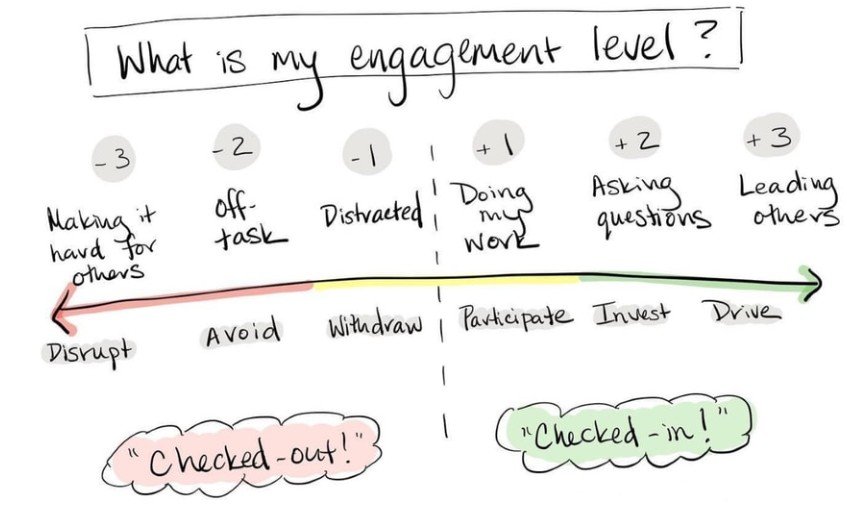
It was posted by a teacher named Doug Doblar as a link to his blog where he discusses his use of this in his classroom. He hangs a copy of this at each whiteboard station for student’s to refer to and uses it to get students back on track.
This line chart is visually appealing and easy to read. It also clearly reminds students of where they should aim to be. Every year I have a handful of students who need reminders throughout the class to move closer to their group, take the marker more, stay engaged, join the conversation, the list goes on. I am hoping that by laminating and hanging this line chart right at the top of each whiteboard station, students will have a constant visual cue to aim for high levels of engagement.
Each day when students are at the board, students get a classwork score mainly based on their participation and slightly based on how far they got on the thin-slicing task. I might try to change this so that their grade for the day is based on where they were on this engagement line chart. I still need to think about this piece more.
Another battle that I consistently have is dealing with students who are ‘marker-hogs’ and students who avoid taking the marker. I really try to look around throughout class and notice if a group is not working well - only one student’s handwriting is present on the board, one student is passively and quietly standing and watching as another student cannot help themself but fly through the problem.
This is NOT how BTC should work and I step in immediately when this happens. I wish that this wouldn't even occur at all, but each year it comes up every now and then. Here is one way I have dealt with this: as soon as I have to remind a group to share the marker more, those students immediately lose a point on their classwork grade for the day (out of five total points), and they continue to lose another point each time I have to continue to remind them. I do not like having to do this, and I’m sure it goes against the BTC idea of not deliberating on points but rather on student understanding.
Given this issue, I was happy to see the following idea in the Facebook post:
“I sometimes told students that they couldn't use the marker, at all for the first 1 min, 5 min, etc. depending on the task. This greatly increased communication, participation of all members, and quality of responses once marker use was allowed. It also decreased marker-hogs.”
This is genius and I'm not sure why I never considered doing this. There are students who try to complete an entire task before their partner(s) have been finished reading the prompt, so this would immediately cut down on this, would force/encourage groups to discuss the process, and would give everyone a chance to process the problem without stressing that they are slowing their group down. It is also easily enforceable in the classroom since it would be obvious if someone were to start writing too early.
I also read this, which I have seen before and which I have told my students many times:
“If you have the marker, you are only the writer. You can only write what you hear from the other members of the group (the ‘thinkers’).”
I do like this idea, and even though I tell my students they should be aiming for this, I am not sure how often this actually happens. However, it was a good reminder to me as a teacher that I need to do a better job of reminding students of this.
THIS is also another great resource to read and then implement in the classroom. It has different single-indicator rubrics for student pairs/trios depending on what they need to improve on.

Each small group of students can draw their own rubric number line at the top of their board to use during that period. Each student grouping can have their own rubric: some might need to work on collaborating (and not just turn-taking) while others might need to focus on taking their time (and not just rushing). I also need to work on not rushing students, but ALSO making sure they are not wasting time. It is important to check in with students during the lesson and have them engage with the rubric. It is not just decoration at the top of their board; they need to self-evaluate and compare their rating with my rating of their group’s performance.
And then I saw this comment with this photo:
“I labeled binder clips for each of my classes to hold the deck of cards and pinned them next to my desk. Definitely helped with keeping them organized.”
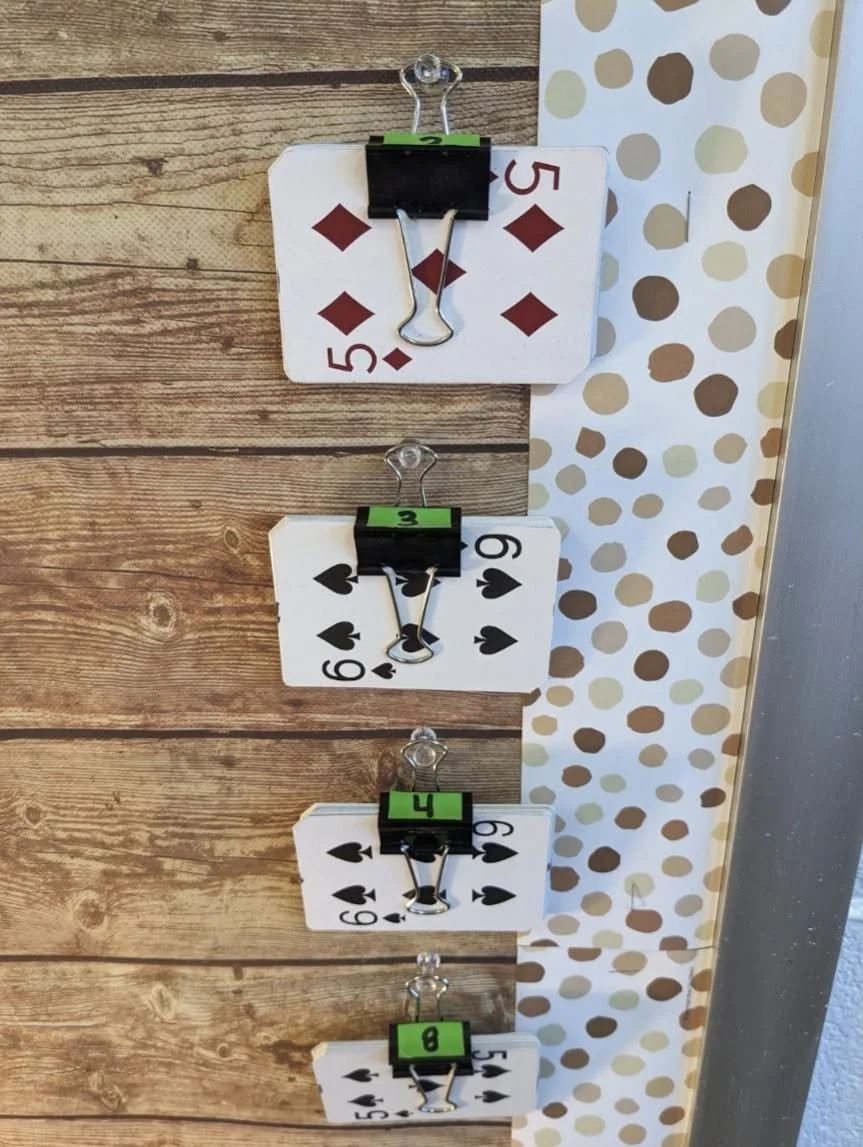
Now THIS is genius! During my first two years of using BTC, I was good about having three separate boxes of playing cards. Each box was labeled with the period number and contained the correct number of cards based on how many students were in that class. This year I got lazy with that and decided to just have one deck of cards for my biggest class, and then I would just remove cards quickly before handing them out to my smaller classes. Well this was a bad idea and ended up wasting a minute or two each time I needed to hand our cards to the smaller classes.
I also need to do a better job of getting the cards back from students after I hand them out. I used to walk around the whole classroom collecting cards about couple minutes after everyone was at their board and settled. And then this year I stopped doing that and asked students to put their cards on the table that had the thin sliced tasks laying on them at the end of class as they left. This was also not the best idea, because once that bell rang to leave, the only thing on a student’s mind is GET TO THE DOOR NOW. Students would sometimes forget to leave their card on the table, and then my deck of cards was too small for any of my classes and I’d have to figure out which cards were missing and replace them quickly with my stash of extra cards.
This sounds sloppy and I am going to fix this by using the binder clip strategy with three separate decks for my three algebra 2 classes next year and I am going to re-commit to collecting cards right after students have made their way to the boards.
The next issue I am going to try to tackle this year is attendance: both how to improve student attendance and how to improve my method of recording student attendance.
Up until this past school year, my school always provided me with a paper record=keeping book which I used to keep track of student attendance and homework completion (when I walked around and spot-checked assignments). I would then manually transfer the homework assignments into Google Classroom (or whatever computer grading system I was using that year) every two weeks or so. I know that this is not efficient and I cannot get myself to stop doing this. I even bought an iPad with the idea that I would walk around with my iPad instead of my paper record-keeping book and type each student’s grade directly into the Google Classroom assignment, thus eliminating the paper middle-man so to speak. For some reason I never ended up using my iPad to do this. I cannot even logically explain why. I just love paper and keeping track of things in a physical book. Note that I DO NOT use my record book for anything I COLLECT from students, including quizzes, tests, exit slips, worksheets, etc. Those are graded by hand and then immediately entered into Google Classroom before being handed back to the students.
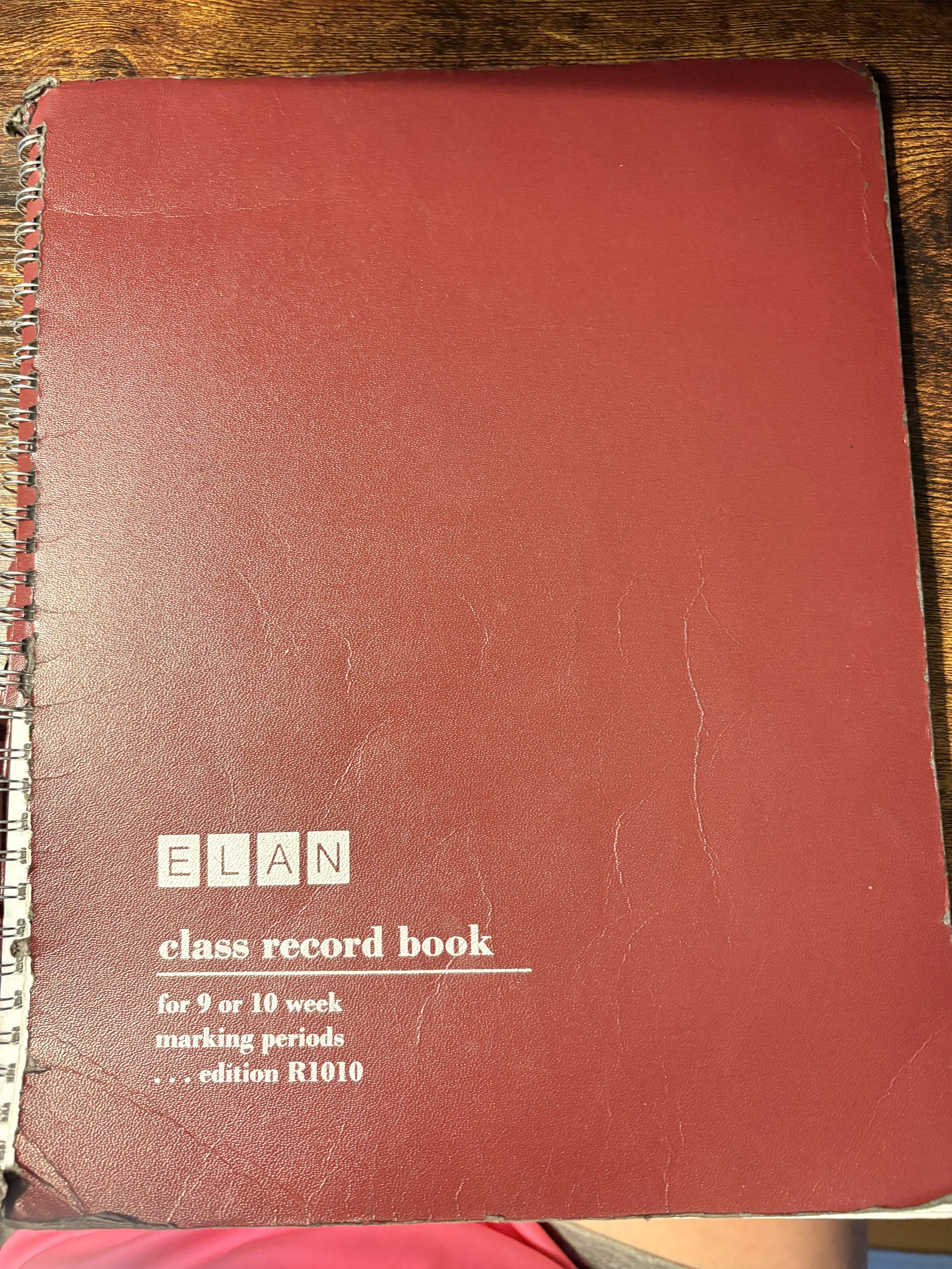
Well I think I am just about the only teacher left at my school using a paper record book, so my school stopped buying them and I had to buy my own for this past school year. I spent a ridiculous amount of time on Amazon trying to find the perfect one with enough room for attendance plus numerous pages per period for all the assignments each quarter. The box size is what threw me off - I thought I wanted a small box size, so I settled on this Elan R1010 record book:
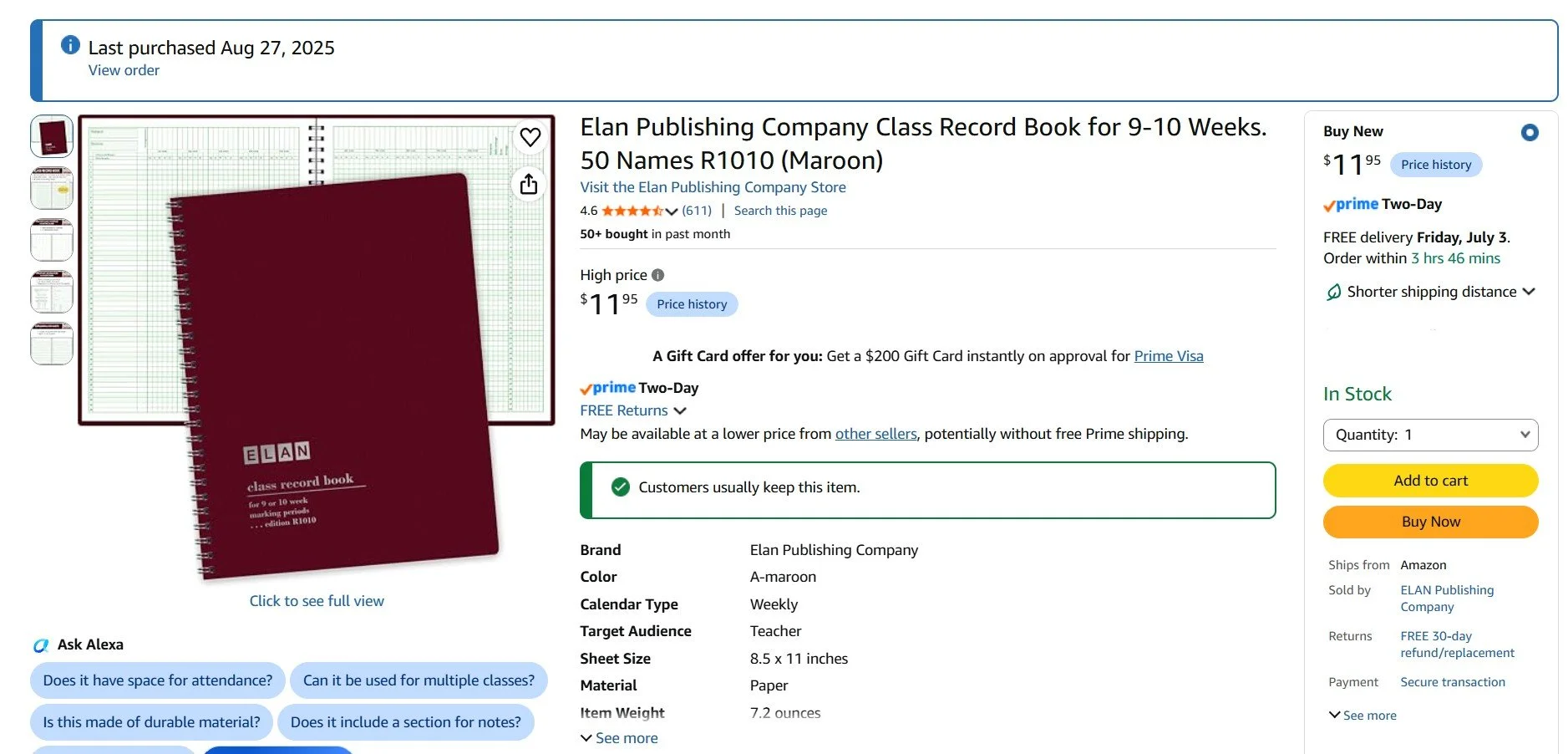
The price was fair and there was enough room for 50 students. This is way more than I needed, but I had a plan to write student names every other row and then have another box underneath to make extra annotations or mark for an assignment if needed.
The pages have perforation which is absolutely critical.
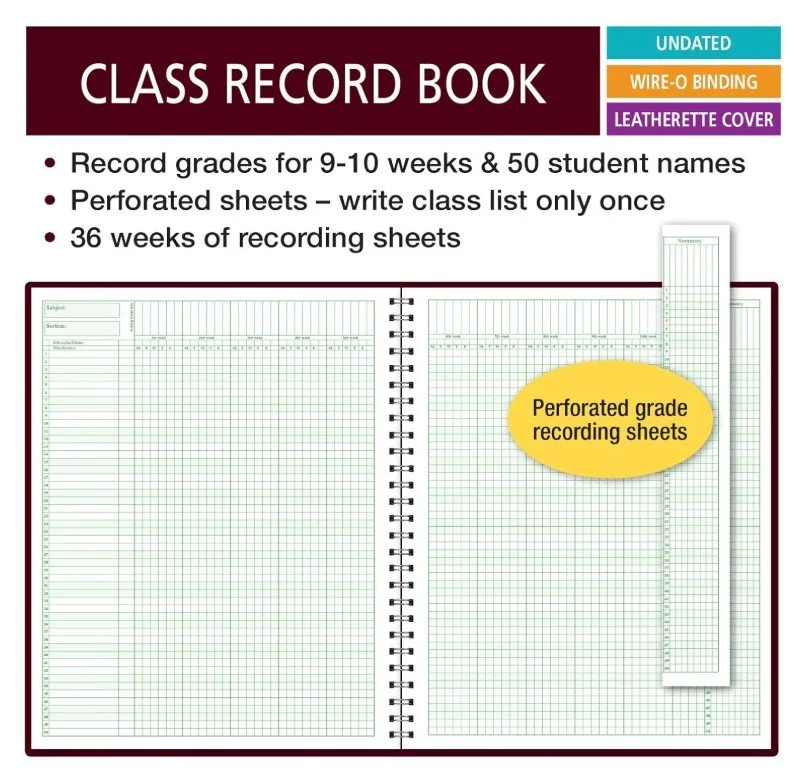
The record book had ideas for how to keep precise and accurate documentation of attendance and grades. I really should have followed their advice of color-coding things:
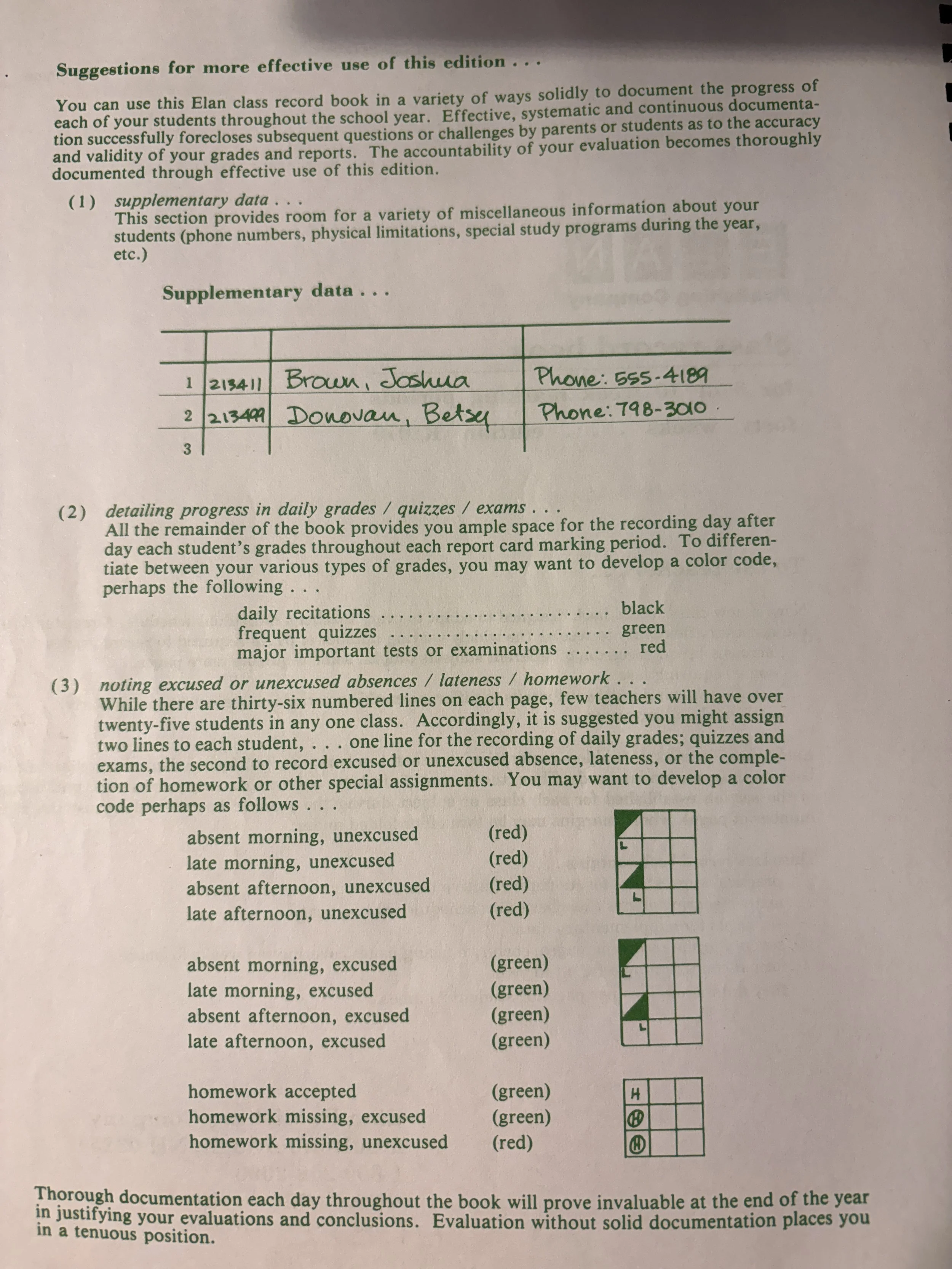
The reality was that this record book barely held up throughout the whole year with almost daily use, the boxes were MUCH too small, and it ended up being very cramped, chaotic, and hard to interpret at times. A record book like THIS would have been better - it has only 38 rows going down (still
This is the front and back of my record book on the last day of the school year:

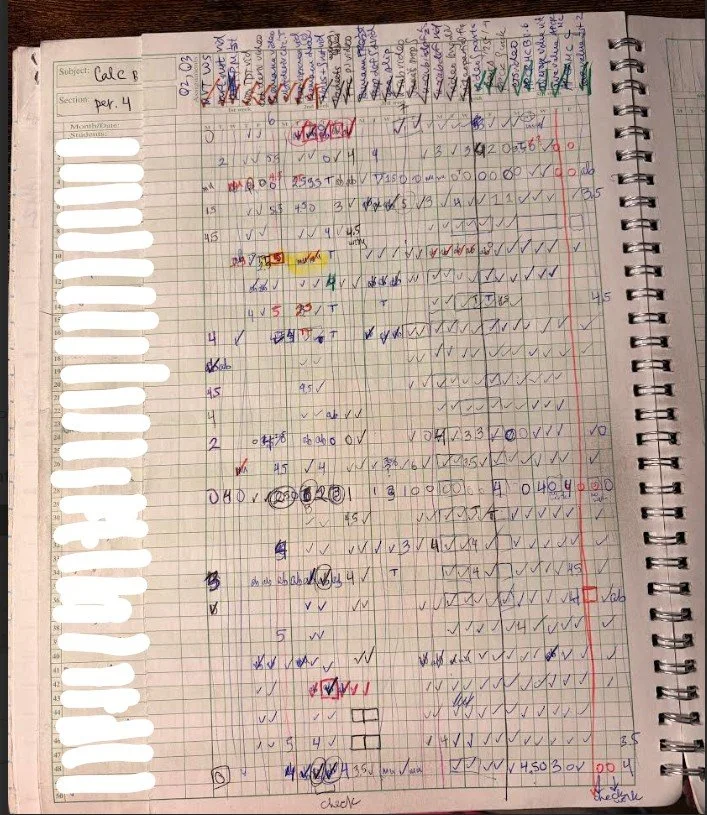
This is what a typical page looked like: this was for one of my AP Calculus BC classes which had 25 students in it. It was hard to get around to all 25 students on days when I needed to check video notes or homework, so I would draw an outline around a box if I didn’t get to a student that day. If a student is absent the day I check, I write ‘ab’ in the box. If a student watches a video notes assignment late (after midnight the day before it is due), they get a ‘T’ in the box and lose one point out of five total points. If they watch the video right before class during another class, they get a ‘TT’ written in the box and lose two points. I want to start taking off more credit, because what’s the point of watching it then if you’re in another class? Students claim they watch during study hall, but I am not going to go and check each student’s schedule and make sure that they were in a free block when they watched it in school. They need to be taking the time to watch the video notes distraction-free the day before when they are ideally not rushing to get it done (all very idealistic thinking).
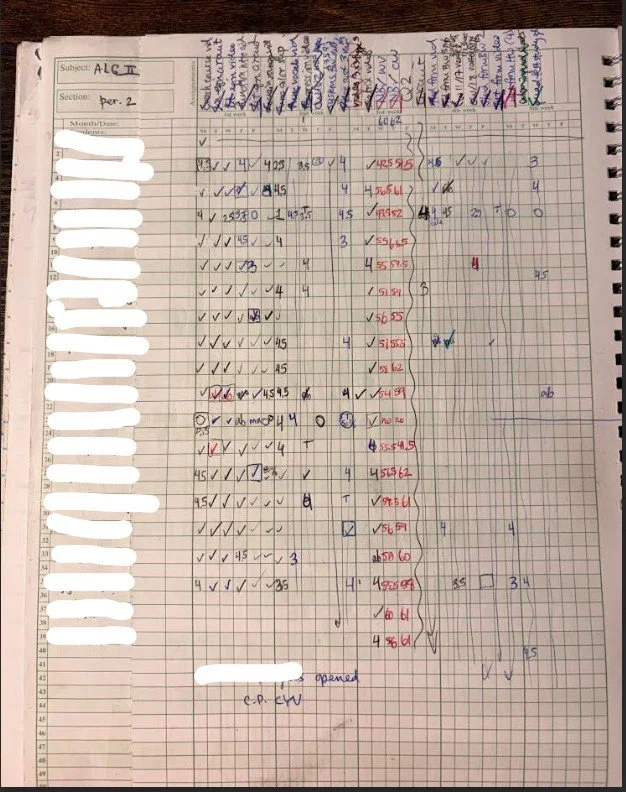
This is what a typical page looked like for one of my Algebra II classes:
So now let’s move on to tracking student attendance. This is what a typical page looked like for one of my AP Calculus BC classes, which almost always have only seniors. If a student is absent, I write the date they are absent in a box next to their name. If they are tardy excused, I write the date with a ‘TE’ next to it, and if they are tardy unexcused, I write a ‘TU’ next to it. This easily let’s me see who has chronic attendance issues. As you can see from the two photos below, I had quite a few students this past year with many absences:
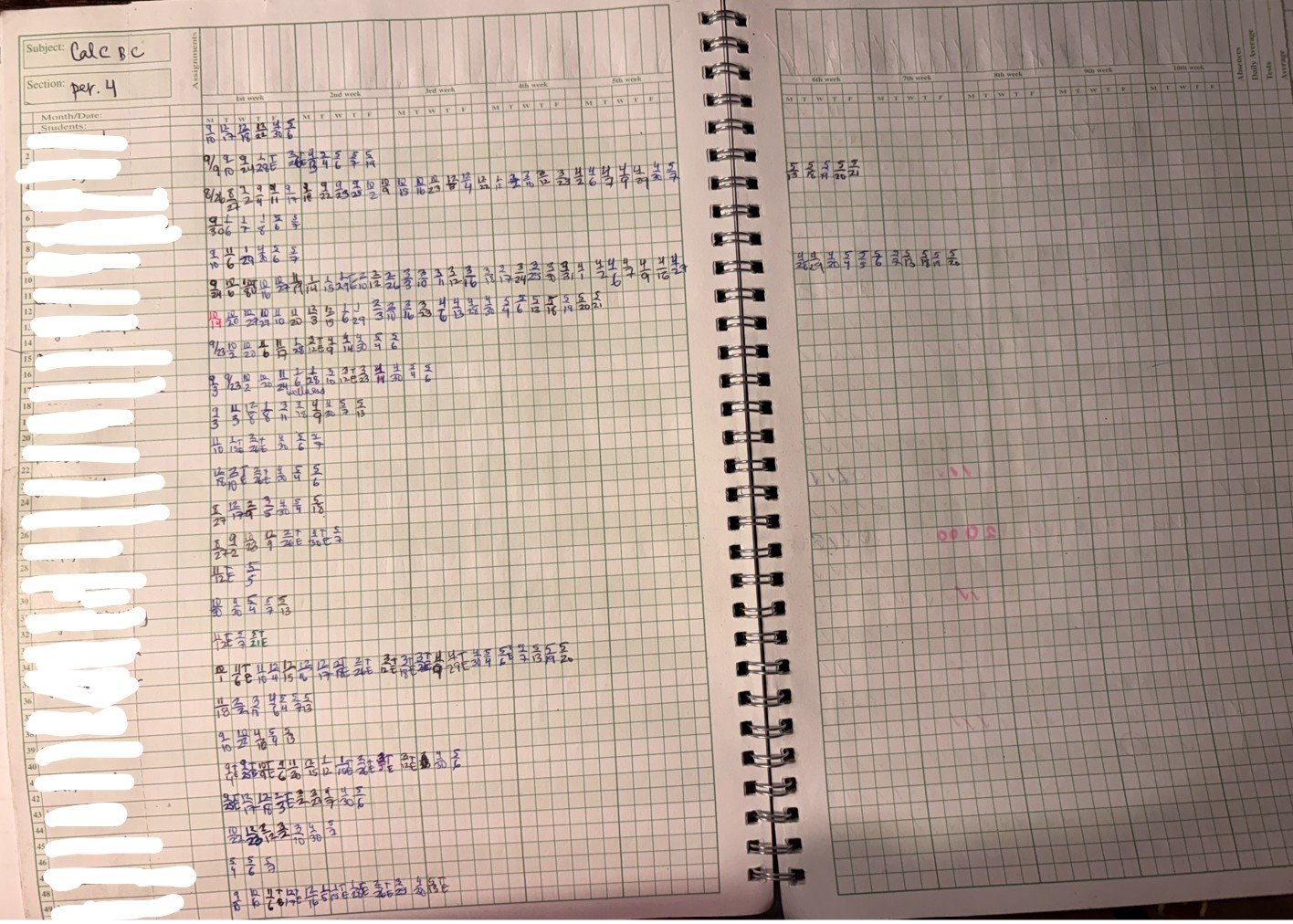
This is what a typical page looked like for one of my Algebra II classes, which almost always have only sophomores. My sophomore always have better attendance than my seniors.
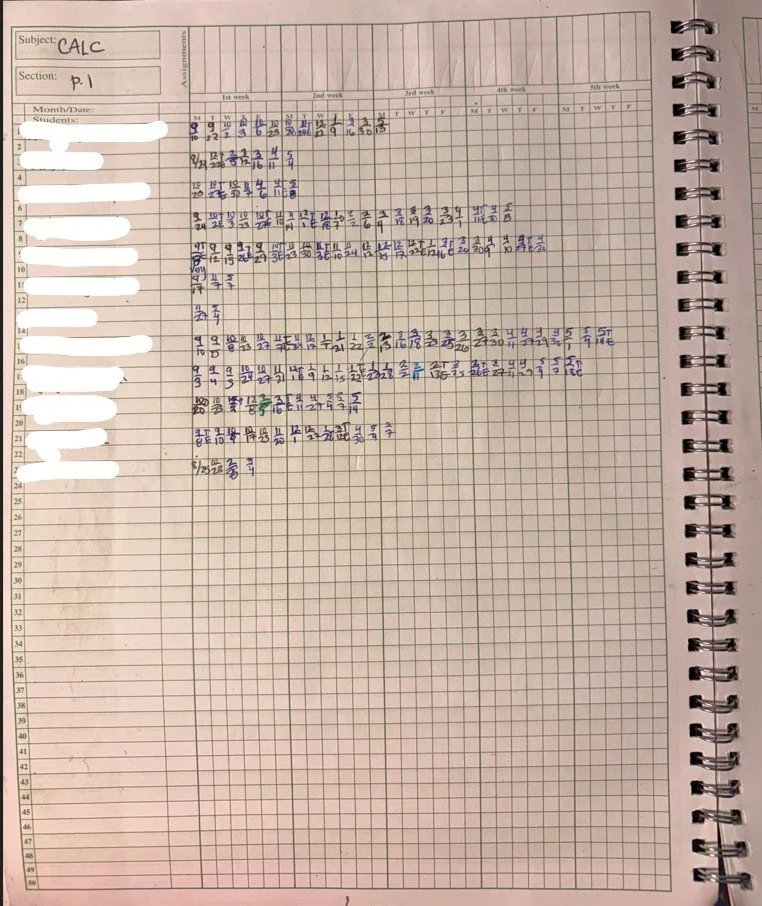
Student attendance dropped significantly after Covid and never fully recovered. Our school does have consequences in place for seniors who have over 14 unexcused absences, but they involved community service to be done after the seniors’ last day of school, which doesn’t help them at all in their actual classes. The schools are in a tough spot, though, because our district’s school committee does not require students to have fewer than 14 absences. We have students in our district with 50 or more absences during their senior year still graduating. The seniors know they can get away with missing numerous days of school and still graduate, so it is difficult to have any real requirements or consequences in place. If a student is sick or ‘sick,’ their parent/guardian just needs to call the school and state the student is sick without needing a doctor’s note. Previously, a doctor’s note was needed to excuse an absence.
All of the above issues are completely out of my control, and all I really want is for my students to be in class as much as possible, because everyone knows how important attendance is to student success!
Luckily for me, I visited Virge Cornelius’ blog again during the AP reading in June once I found out that she was retiring. I was curious if she had posted anything formally on her website about her upcoming retirement. While I was on her blog, I started reading posts and found this excellent post on student attendance:
Student absenteeism seems to be a wide-spread issue across all states in all types of schools. I absolutely LOVE her ideas of using different incentives to encourage students to attend class every day. I am planning on implementing at least a couple of these for this upcoming school year.
I really like her idea of pulling student names each Friday to give rewards to students who had perfect attendance in class that week: rewards that are both in the form of ‘points' (or something to boost their grade in SOME way) and in the form of a little prize or token of sorts (not related to their grade at all). Unlike Virge, I don’t think I would pull around 25% of student names from each of my 5 classes each Friday - that seems like a lot. I am considering pulling 1-2 student names per class each Friday.
I also love how she sends out messages to the parents each time she has perfect attendance in all of her classes in a single day - this could easily be done with our school’s Infinite Campus portal. It is just a matter of being diligent and disciplined enough to do this at the end of each day once I know if I had perfect attendance or not for that day.
I am not sure I have the whiteboard space or the bandwidth to keep up with the ‘attendance runs’ that she describes, but it is a cute idea that I know students would get excited about in some way.
Now I do input student attendance every period on my laptop using our Infinite Campus portal, but I still really like having it on paper since I find it quick and easy to refer to, plus I think it would be simpler for me to easily scan across and see who had perfect attendance that week, OR see if every class had perfect attendance for a single day.
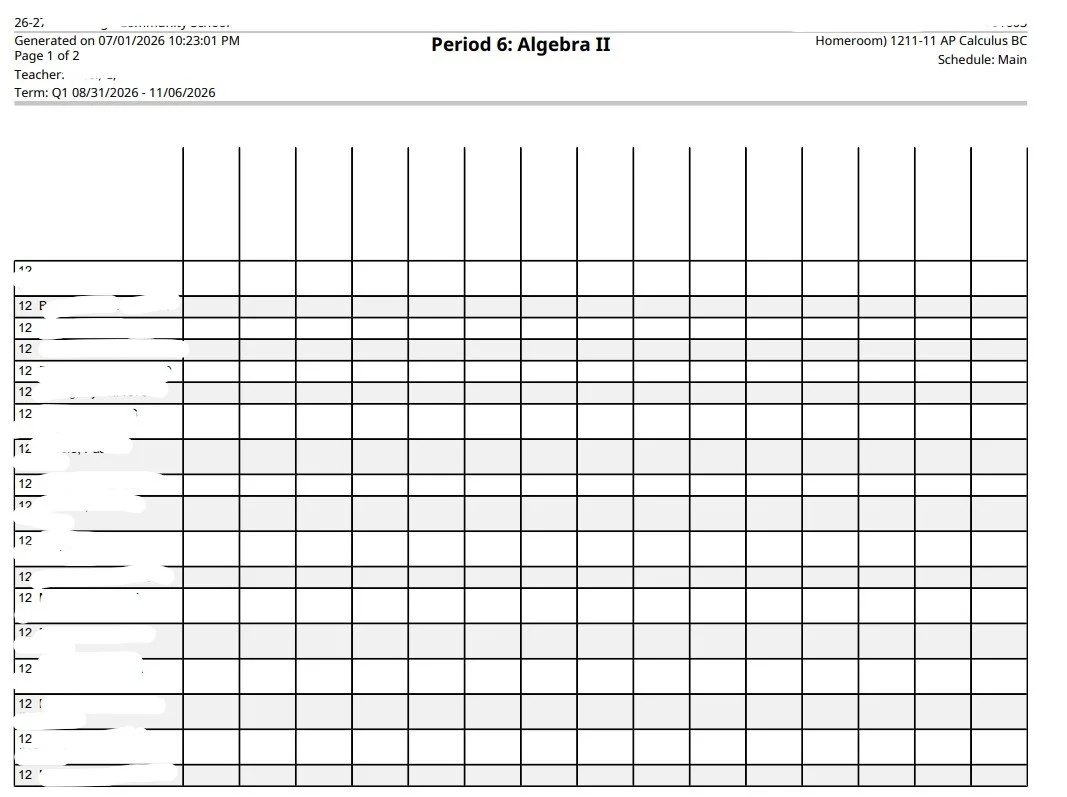
I looked around on Infinite Campus more just now, because it can make some pretty helpful PDF reports, something that I do not take full advantage of. I clicked on ‘Attendance Register’ to see what it produced:
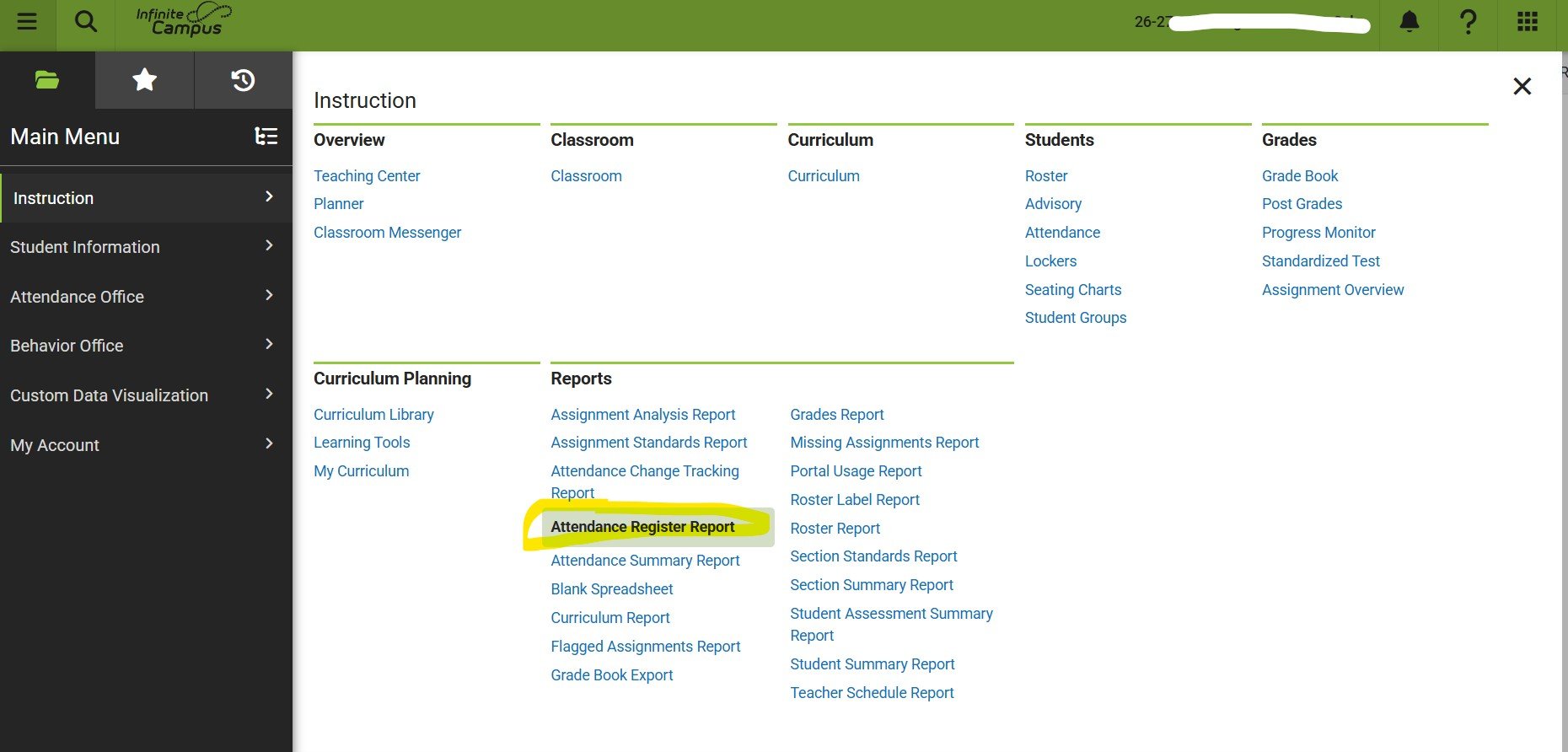
The PDF report produced is exactly what I want to do for next year:
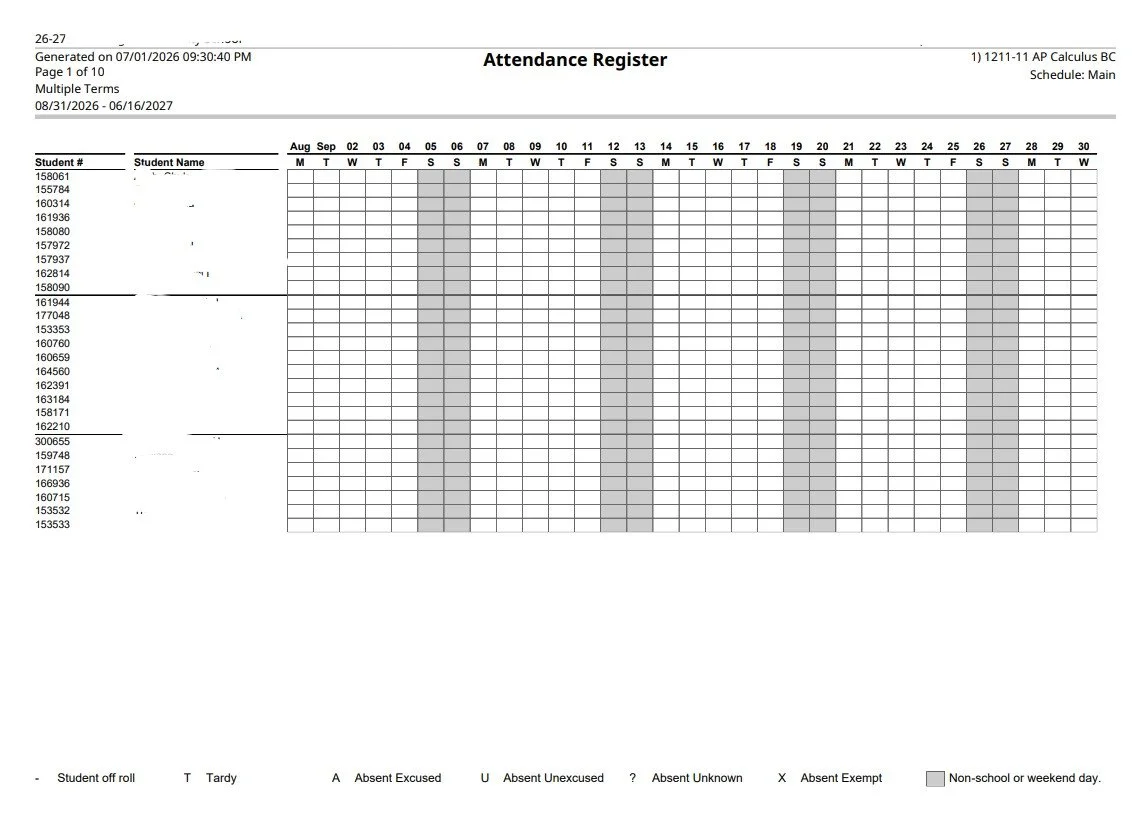
I only took a screenshot of page 1, but this PDF was 10 pages long, with a page for each month of the school year. I am planning on printing out the entire year’s worth of attendance sheets for each class and binding them together into an attendance booklet. I prefer this method of attendance tracking where there is a box for EACH DAY whether they were present or absent, rather than my method of only filling out a box if they were absent and filling the box in with the date they were absent (or tardy).
This new PDF would easily let me see if a student had perfect attendance for the week, since each week is so clearly marked and labeled.
If I use this for attendance, maybe I can wean myself off of the record book completely by recording homework and classwork grades with the ‘Blank Spreadsheet’ PDF option. I could print a couple of these for each class per quarter and make another booklet for spot-checking assignments.
I will continue thinking about how to streamline my record keeping, but I am fully committed to the incentive ideas shared by Virge to try to help improve student attendance.