2026 AP Calculus Reading Debrief
My third year as an AP Calculus Reader came and went in an end-of-year blur. The reading began on June 11 and ended on 17. During this time I also gave final exams to my Algebra II students, graded those, calculated quarter 4 and final grades, entered grades online, and hosted family from out of the country. It was a very busy couple weeks, and it felt like all of a sudden summer had arrived. I’ve had a couple days to relax and get caught up on random things that had been neglected during this time, and I am fully embracing the summer freedom now!
This year, I was really hoping to grade AP exams in person, and I requested this when I responded to the invitation to be a reader again, but alas, I was asked to grade remotely.
I really enjoy the entire process of scoring AP exams and consider it to be not only an honor, but also excellent professional development as an AP teacher. You get information directly from the source on exactly what students should be doing, what notation they should be using, what they should avoid, etc when answering the Free Response Questions (FRQ’s). So for these reasons, I always accept the offer to grade remotely. However, someday I really hope to attend in person to meet some other passionate Calculus teachers and share resources, ideas, and best practices. I also would love to be able to att3nd the Open Forum that is held every year for the on-site AP Readers. At this presentation, CollegeBoard shares all the breaking news, trends, and future vision of AP as a whole. Luckily, an AP teacher who attends the in-person Reading wrote up a summary of the major points that were discussed:
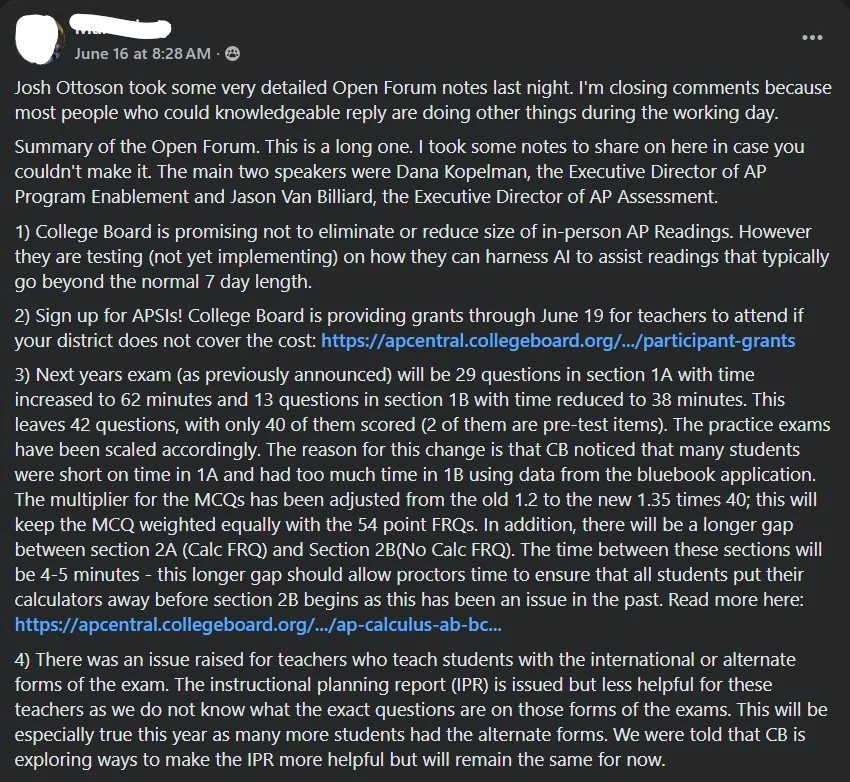
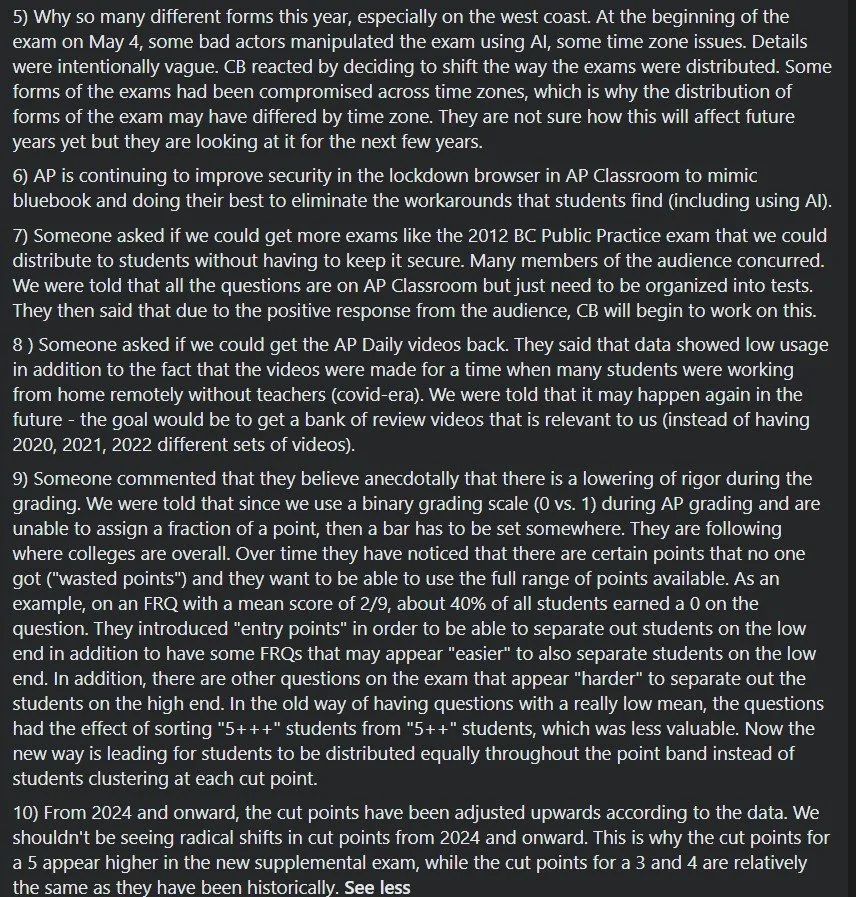
Most of these points were not new news to me, but some of them were and concerned me as I read them - mainly the first point regarding the use of AI to score student FRQ responses. I am wary of the increasing use of AI to score student written work and consider it a cop-out to true grading and feedback. As with everything else in the world, CollegeBoard’s decision to include AI in the scoring process all has to do with saving money (and saving time, which saves money). I can see how it would be possible to quickly score the calculator-active FRQ’s with AI without too much difficulty, but based on my experience and my table’s experience grading our FRQ this year, there are MANY nuances, exceptions, special cases, and other considerations that would make it difficult for AI to grade the non-calculator FRQ’s. My ‘table’ included about 9 other readers along with our table leader, and I cannot emphasize enough how many messages we had to send to our table leader, how many messages our table leader had to send to us, how many messages our table leader had to send to our question leader, and how many updates regarding changes in grading that occurred while the reading was taking place. There were so many student responses that didn’t quite fit the mold and required careful consideration and discussion. I am not an expert in AI but it is difficult for me to imagine how AI could have graded these. Obviously CollegeBoard might have AI do a preliminary estimate of the student score which would then be proof-read by a human reader, but I am not sure that this model would save much time or money.
Point #9 was interesting to read, and I have heard this sentiment before; however, I do overall agree with CollegeBoard’s philosophy when creating the scoring rubric.
Here are the 2026 FRQ’s for Calculus AB and BC.
Before the exam, my students did three of the FRQ’s from the brand-new 2026 Calculus practice exams in class. This was the first Calculus practice exam provided by CollegeBoard since 2019! I wish I had my students do all of them in class, because they said the ones that were similar on the actual AP exam were easy for them. As always, though, time is the issue! There’s never enough time to fit in everything that I want to do, especially when it comes to reviewing.
This year was especially interesting because I was trained for THREE FRQ’s. The past two Readings, I trained for two different FRQ’s: a BC FRQ and then an AB FRQ. After my BC FRQ was fully graded (usually around day 4), my table trained for an AB FRQ to help finish those since more students take the AB exam than the BC exam.
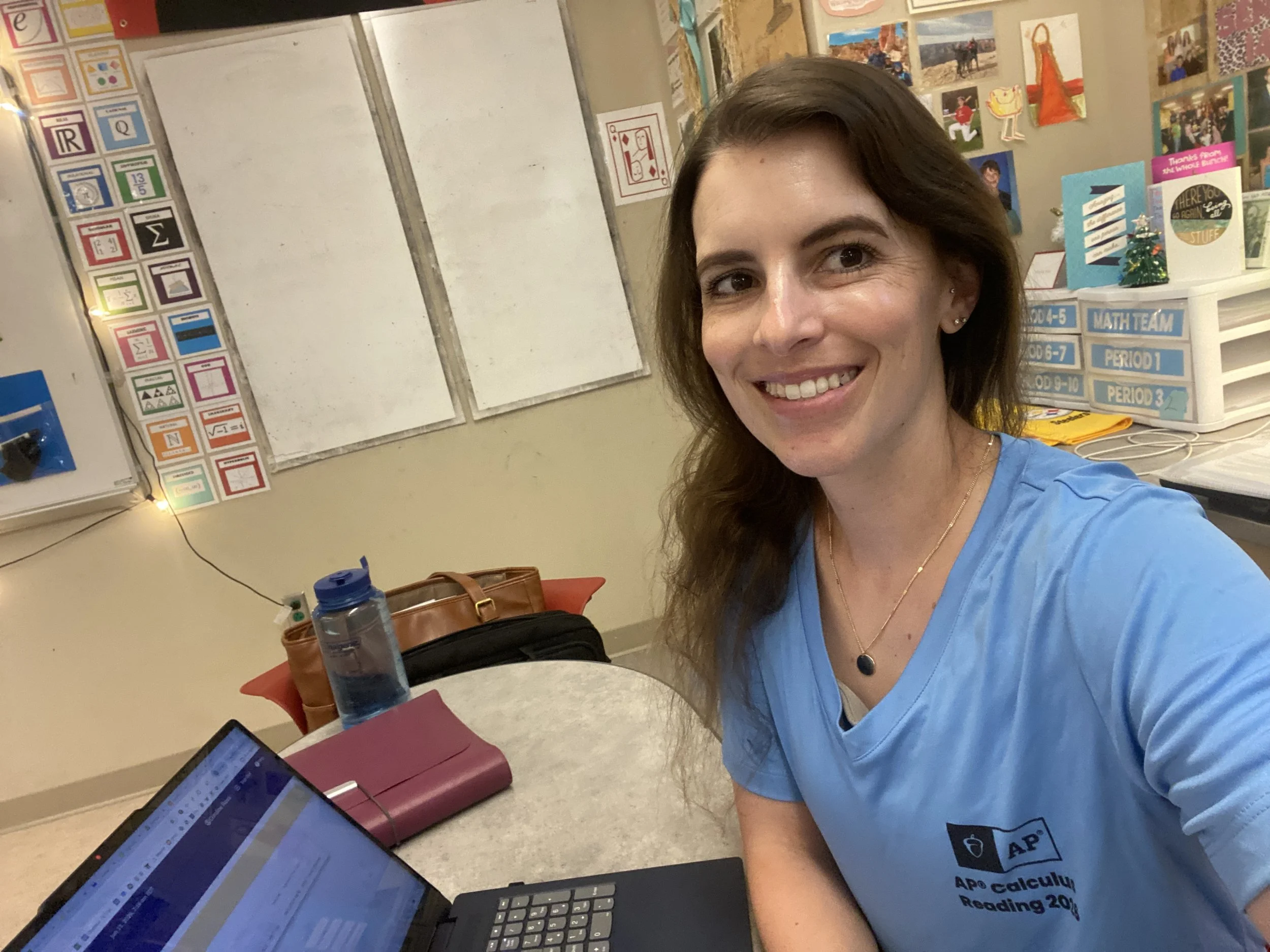
Day 1 of the reading was on June 11. This is me as I anxiously awaited the start time of 8:30 when the ONE website opened. I am wearing the AP Calculus Reader shirt designed by Mark Kiraly for the 2026 Reading.
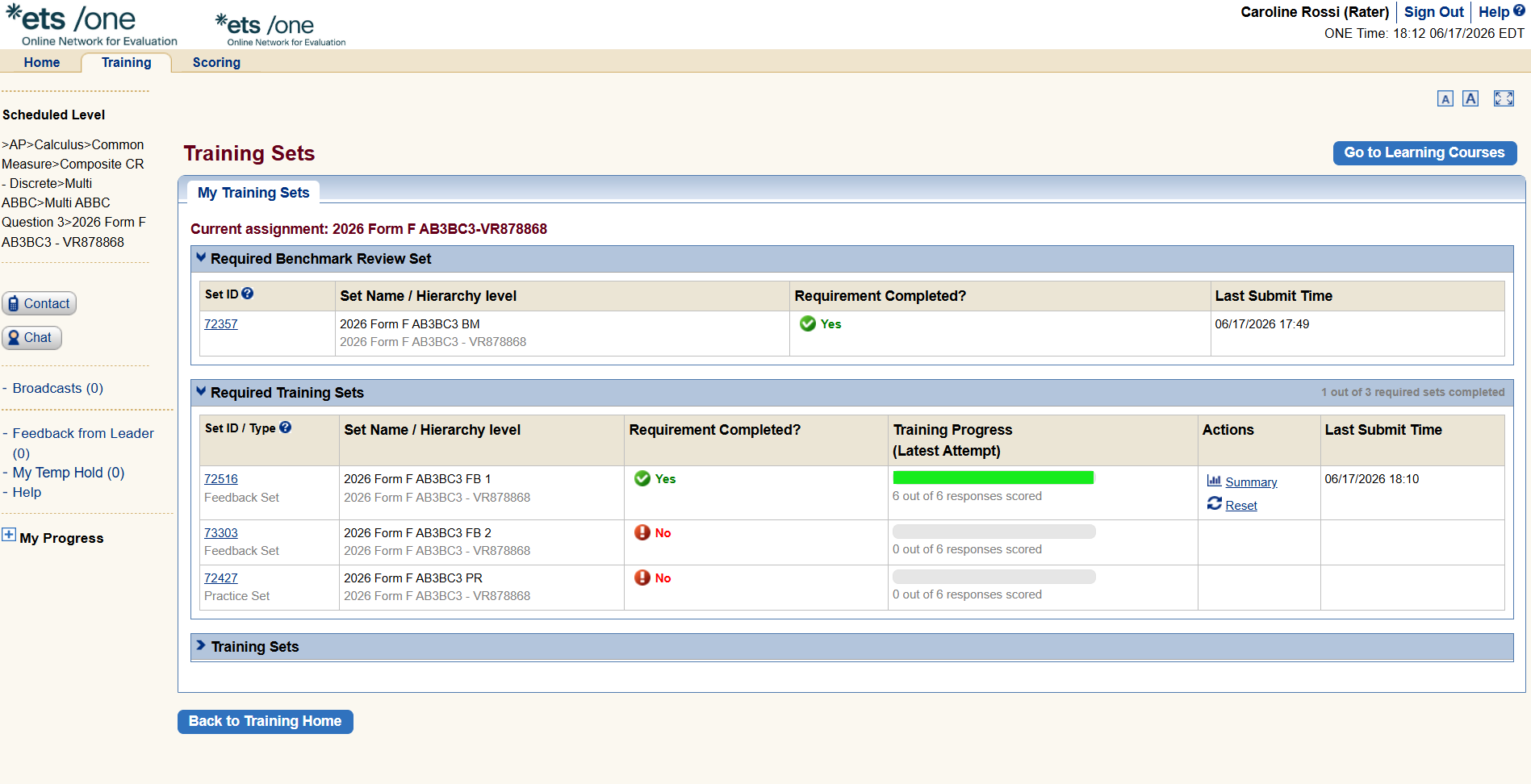
This ended up being a particularly busy day for me in school and at home since I still had my three Algebra II classes to teach, one of which was long block that day, followed by my son’s mountain biking practice and then my daughter’s on-stage dance rehearsal. Needless to say, I just barely finished the GENERAL training (for all AP subjects) and CALCULUS SPECIFIC training for FRQ #5 before the ONE website closed at 9pm for the night. This CALCULUS SPECIFIC training involved making my way through the Benchmark FRQs, then the first Feedback Set with feedback provided for each point, then the second Feedback Set with feedback provided for each overall question, then the Practice Set with feedback provided after I gave a score for all six FRQ’s, and then Calibration, where you either pass or fail based on how close your score is to the score CollegeBoard assigned.
This is what my ONE portal looked like when I was halfway through the training sets:
This is what it looked like when the training was fully completed for one FRQ question:
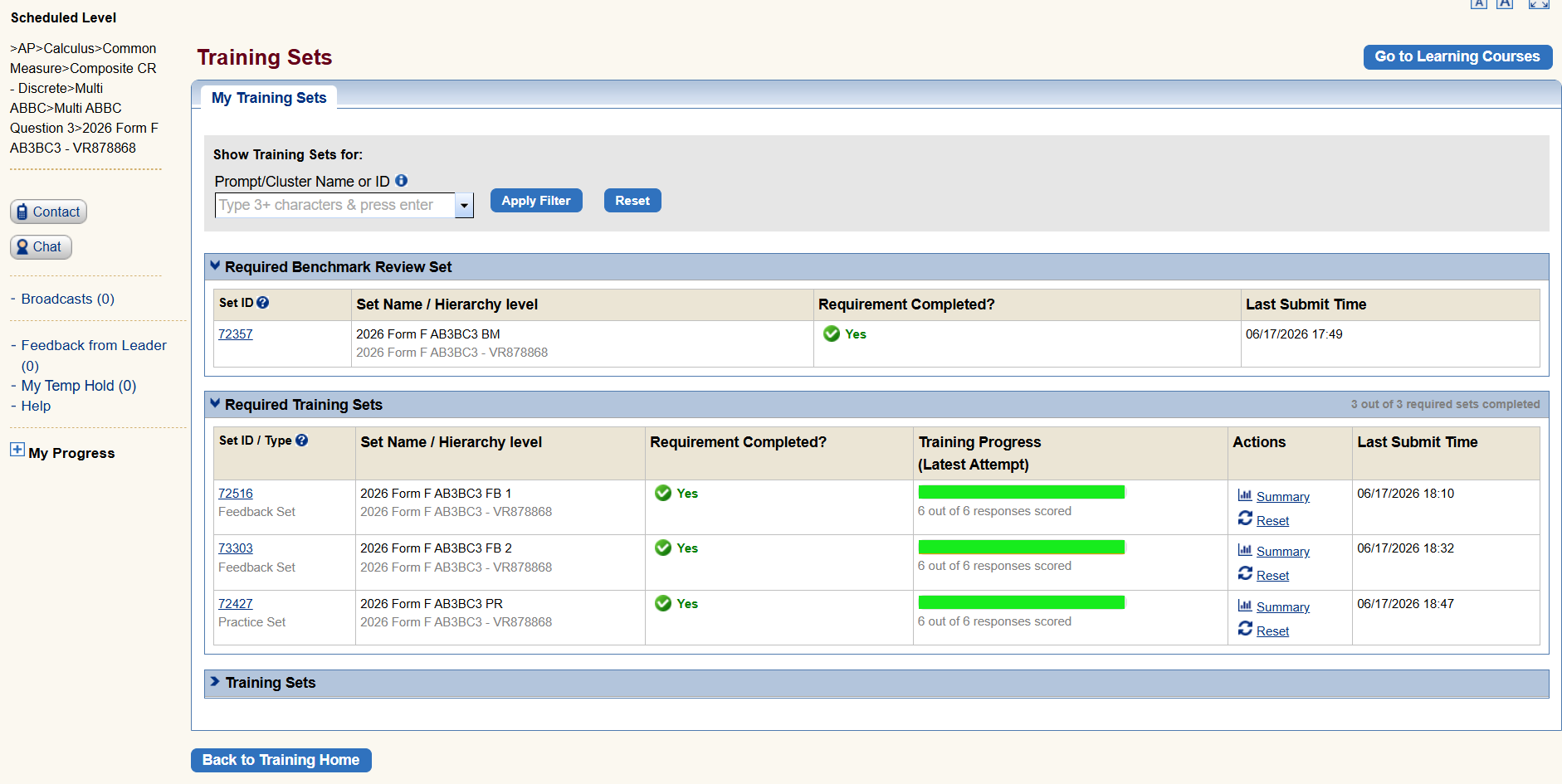
After completing this training, I wish I had been able to begin scoring actual student responses on Day 1, but I had to wait until Day 2 at 7am to do this. My goal for the reading this year was to score at LEAST 1,000 student responses. Last year, I got to 790 during the regular reading and reached 815 after the extended reading (the AP reading was extended the past two years because the student FRQ’s weren’t fully done by the end of the 7-day reading). Last year, I logged a total of 38 hours and 10 minutes by the end of the extended reading.
This year, I wanted to beat my numbers from last year, and I got to 870 FRQ’s and logged 41 hours during the regular reading. One thing that really helped me get more hours in during the 7-day stretch was the fact that the reading did not span Father’s Day weekend. The past two years, Father’s Day was always right in the middle of the Reading and it was so hard to get the six or seven (lol) grading hours I committed to on this day. This year, I could easily reach at least six hours each weekend day without feeling like I was neglecting family time.
The reading wasn’t extended this year, though; it actually ended abruptly on June 17 in the early evening. It wasn’t supposed to be abrupt because CollegeBoard did send out a voicemail to all readers on June 17 in the early afternoon letting everyone know that we were close to the end.
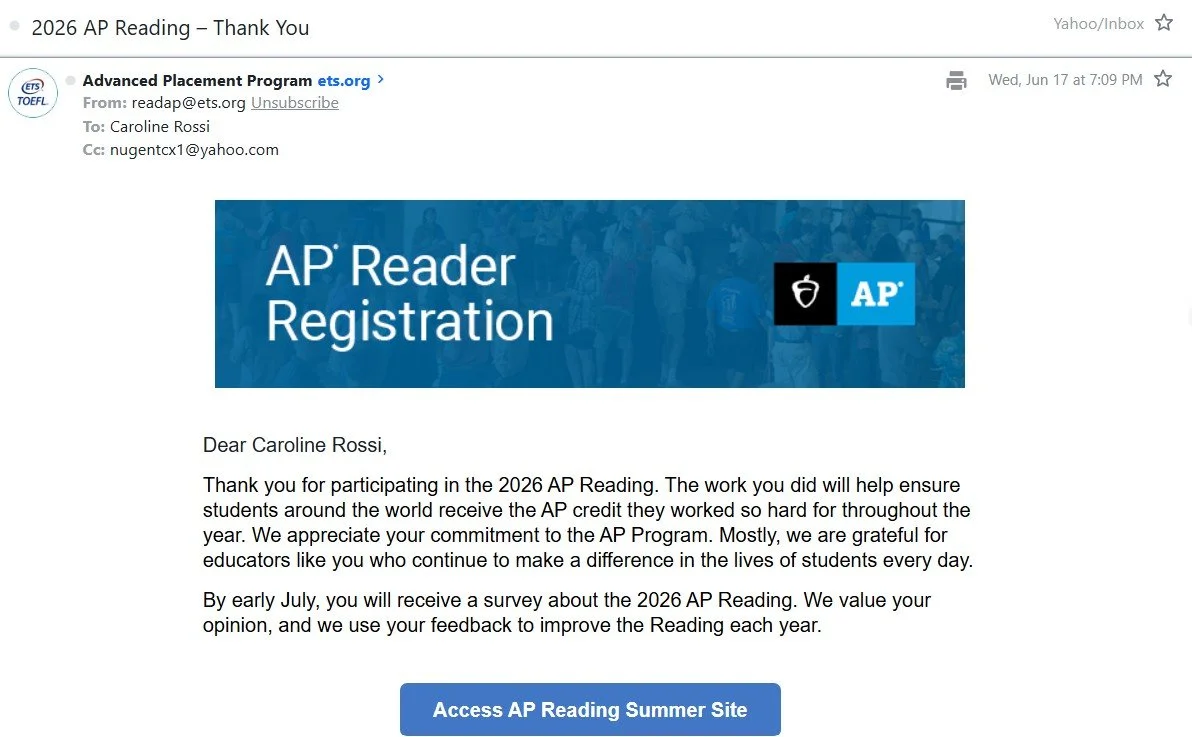
The reason it felt abrupt and somewhat anti-climactic is I had just spent over an hour training for the THIRD FRQ that I thought I was going to begin scoring. I was pushing myself to get through all the training sets so I could get started on student responses. The moment I passed calibration and clicked the button to begin scoring, I got a message saying that there were no more responses to score. I was actually sad when I saw this because I was excited to start scoring this third FRQ. I also had it in my head that I was going to be spending that whole evening grading and trying to reach 1,000 FRQ’s and then all of a sudden it ended before dinnertime. As ridiculous as it sounds, I felt somewhat lost that evening for a bit until I forced myself to start grading my own students’ final exams which had been on the back-burner during the AP reading.
This was the first FRQ I trained for and graded: BC #5. I have to say, it was the most difficult FRQ I had graded in my three years as an AP Reader and required me to send more FRQ’s than ever before to my Table Leader to confirm that she agreed with my scoring.
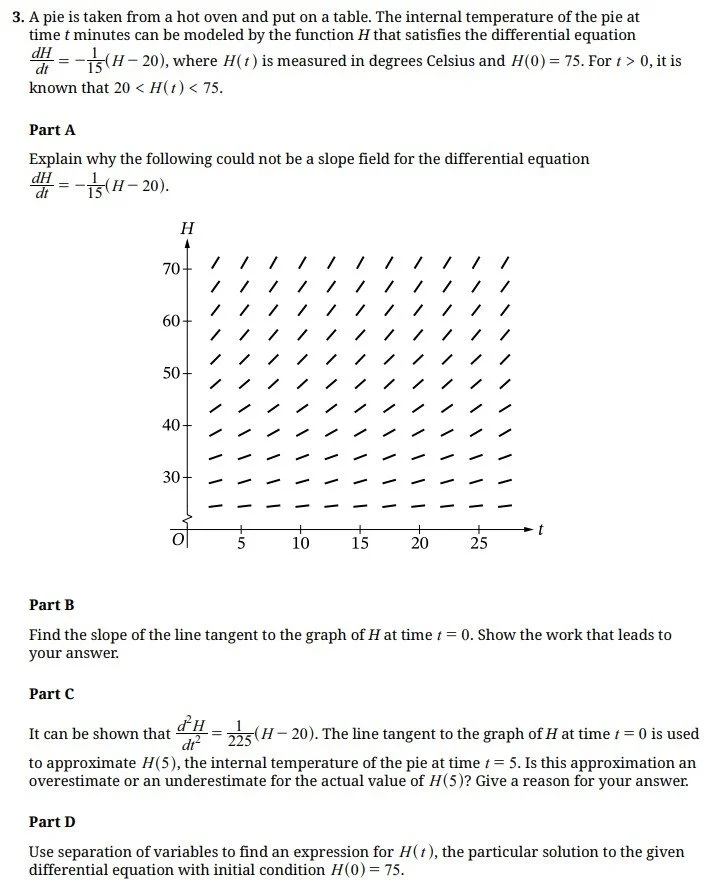
This was the second FRQ I trained for and graded: AB/BC #3. It was significantly easier to grade and had fewer exceptions and special cases. The part that required the most thought and careful consideration was paet (B) with the verbal explanation.
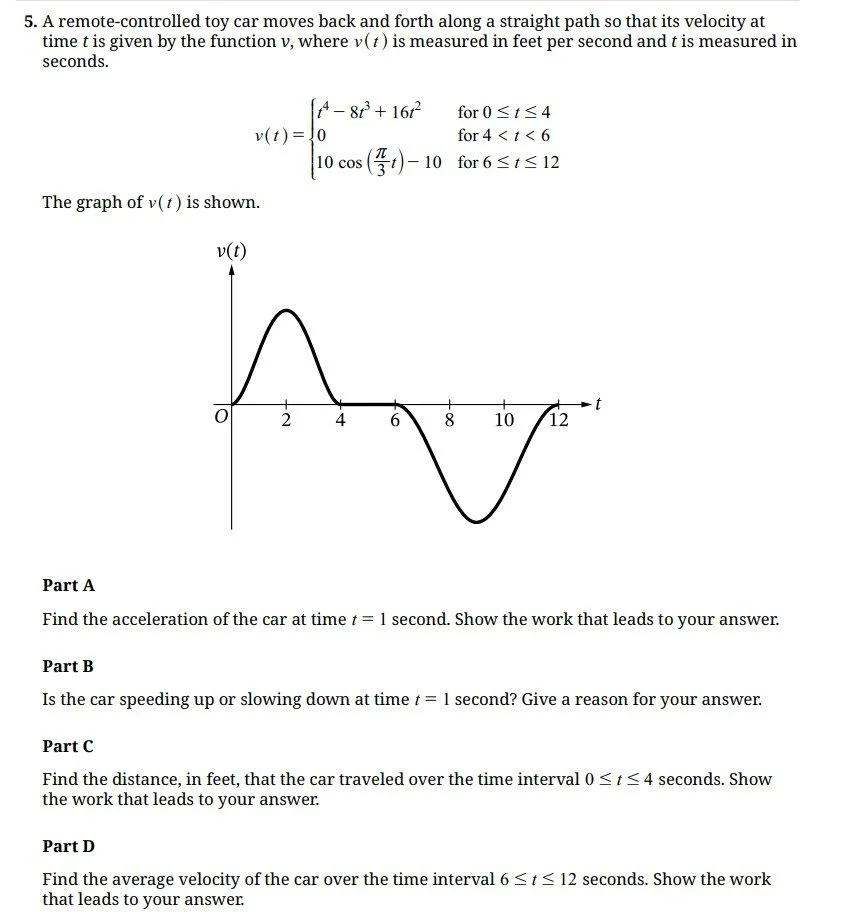
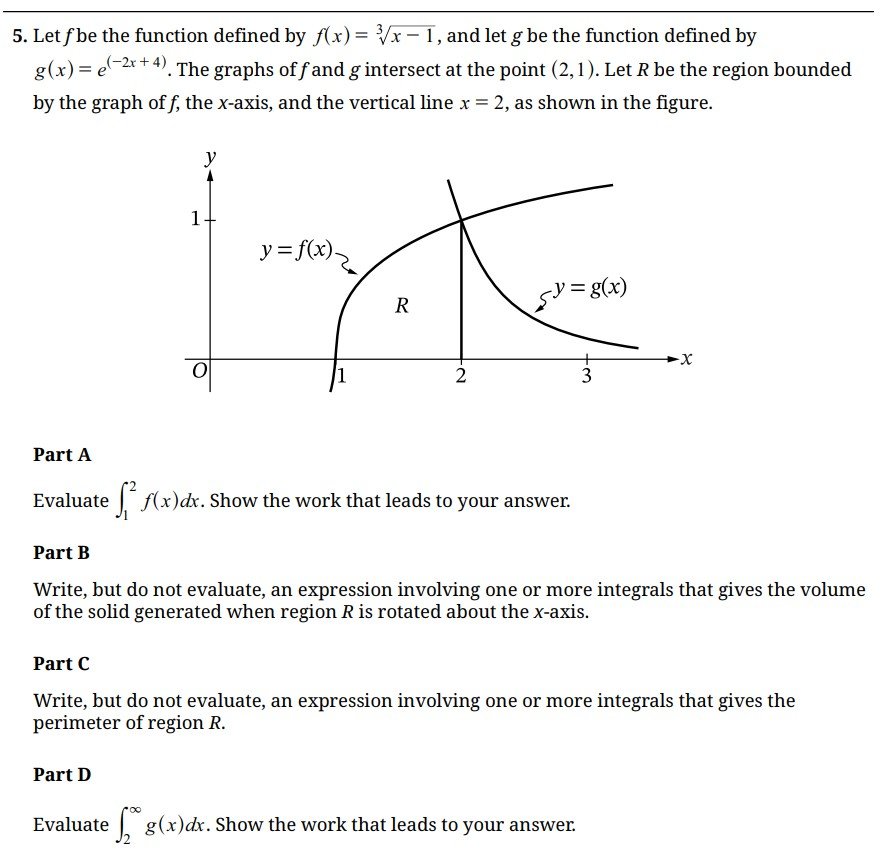
This was the third FRQ I trained for and graded: AB #5. I think this one would have been enjoyably to graded since the training sets went smoothly for me. As I said above, I did not actually end up grading any student responses for this FRQ.
At this point, all the AP exams have been scored, cut scores have been determined, and scoring distributions have been calculated. I finally got a chance today to fill out my Reader survey, which gave me access to the AP Reader Gift Store. Because I am a T-Shirt collector and hoarder, I of course picked the 2026 AP Reading T=Shirt. I almost chose the lunch box/cooler box, because I lost the AP lunch box that I got after I applied for the first time ever to be a reader back in 2020, but I couldn’t resist another T-Shirt.

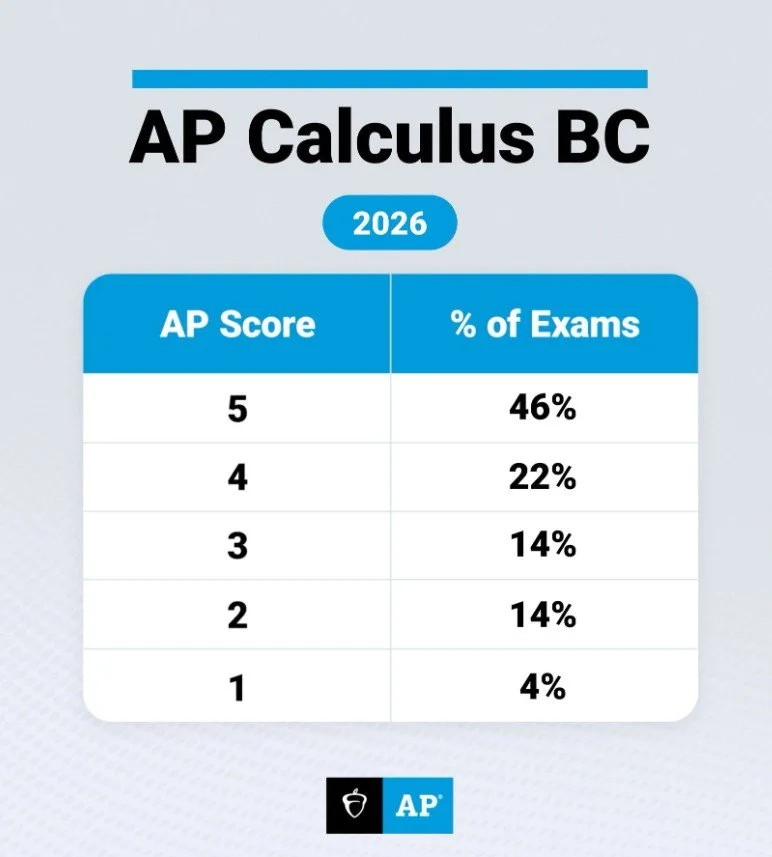
Now the AP exams are all graded, the scoring distribution statistics have been posted on social media by Trevor Packer, the head of the AP program. These are the stats for the AP Calculus BC exam, which was taken by approximately 171,000 students - roughly 1% of the U.S. high school population.
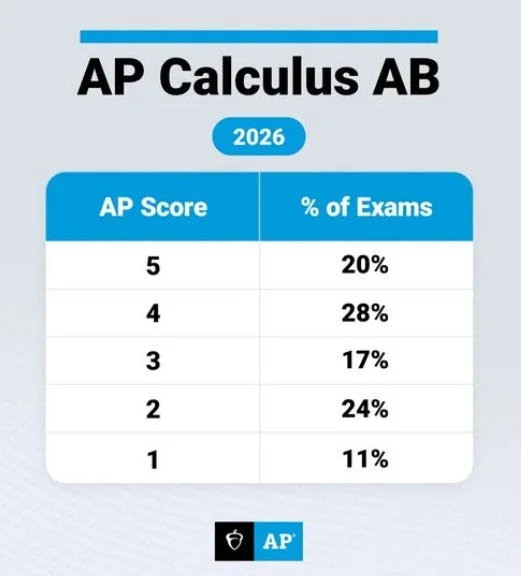
For comparison, the Calculus AB exam was taken by approximately 292,000 students - roughly 2% of the U.S. high school population. Typically, the pass rate for AB is lower than the pass rate for BC.
As is the case every year, I am eagerly awaiting the results to see how my students did. Just about one more week to go before they are released! Good luck to all students as they receive their AP scores!