AP Calculus Bootcamp + Unit Circle Bingo
A few years ago, I BLOGGED about my experience teaching my first ever AP Calculus Bootcamp. Last week, I wrapped up my fourth year in a row of teaching and helping run the AP Bootcamp held at a local college.
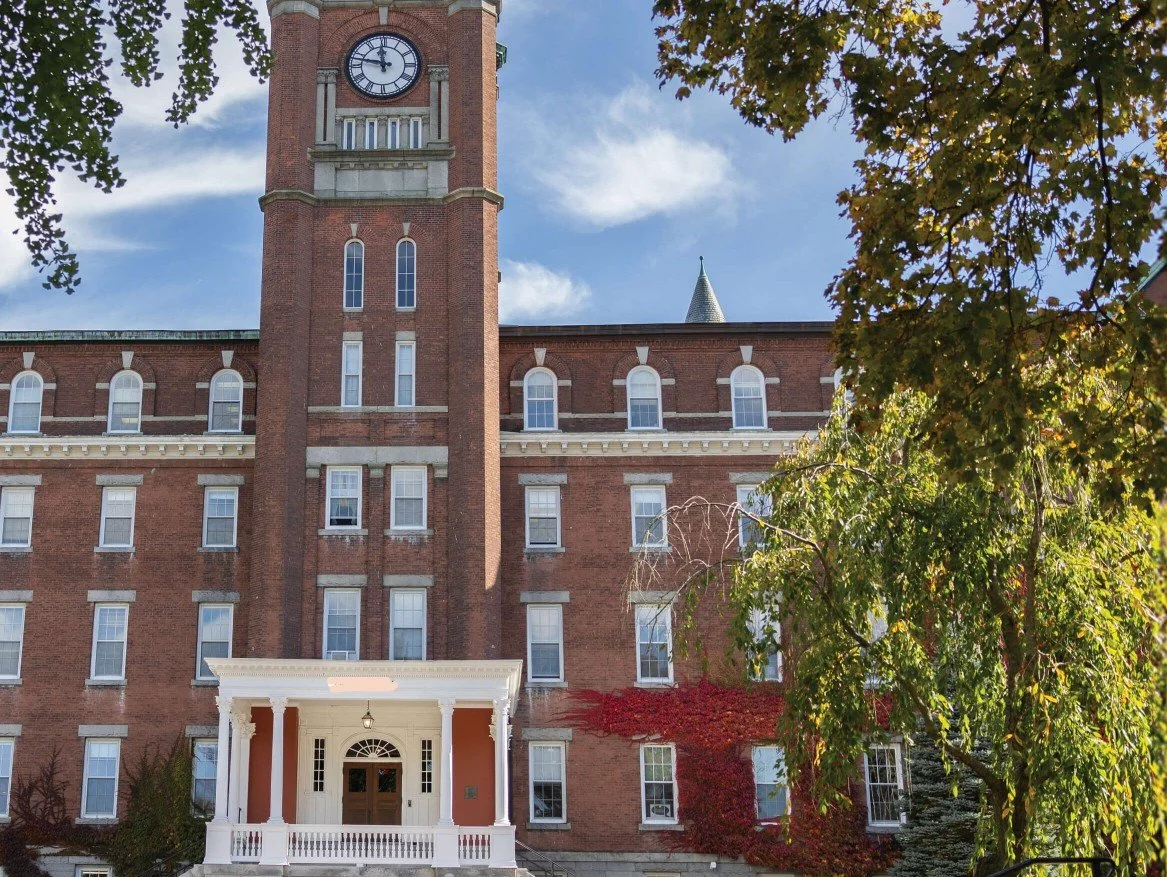
Quite a bit has changed in the past four years, most notably that the program now offers a Bootcamp for AP Chemistry (in its third year now) and AP Statistics (in its first year) as well. The facilities have gone through a major upgrade as well, which was really exciting to see.
The first year, the daily 30-minute breakfast and welcome session and the one-hour college programming session were held in my classroom, which was no issue because my classroom was the only classroom used (only AP Calculus Bootcamp was offered). These college programming sessions have covered topics such as FAFSA and financial aide, the college essay, demonstrating intent to a college, the application process, building a college schedule, Q&A sessions with current college students, and a campus tour. The second year, the breakfast and welcome session was still held in my class for my AP Calculus students and the AP Chemistry students. Then, the one-hour college programming sessions were held in a historic library room after lunch each day.
The problem with this set-up was that this old library room had a very tall ceiling, giving it an almost church-like feel, and the room had many windows, making the projector screen very difficult to see and read. As a result, several students would sneak out after lunch and skip the college programming sessions, which was disappointing for the college. Out of those that stayed, many went on their phones during the presentations. A lot of effort was put into creating and presenting these really informative sessions, but the location was just not ideal.
Then, last year, the lengthy construction and renovations on the admissions building came to an end, and we were finally able to use the beautiful, comfortable, and welcoming Enrollment Welcome Center, which has a lounge feel to it.
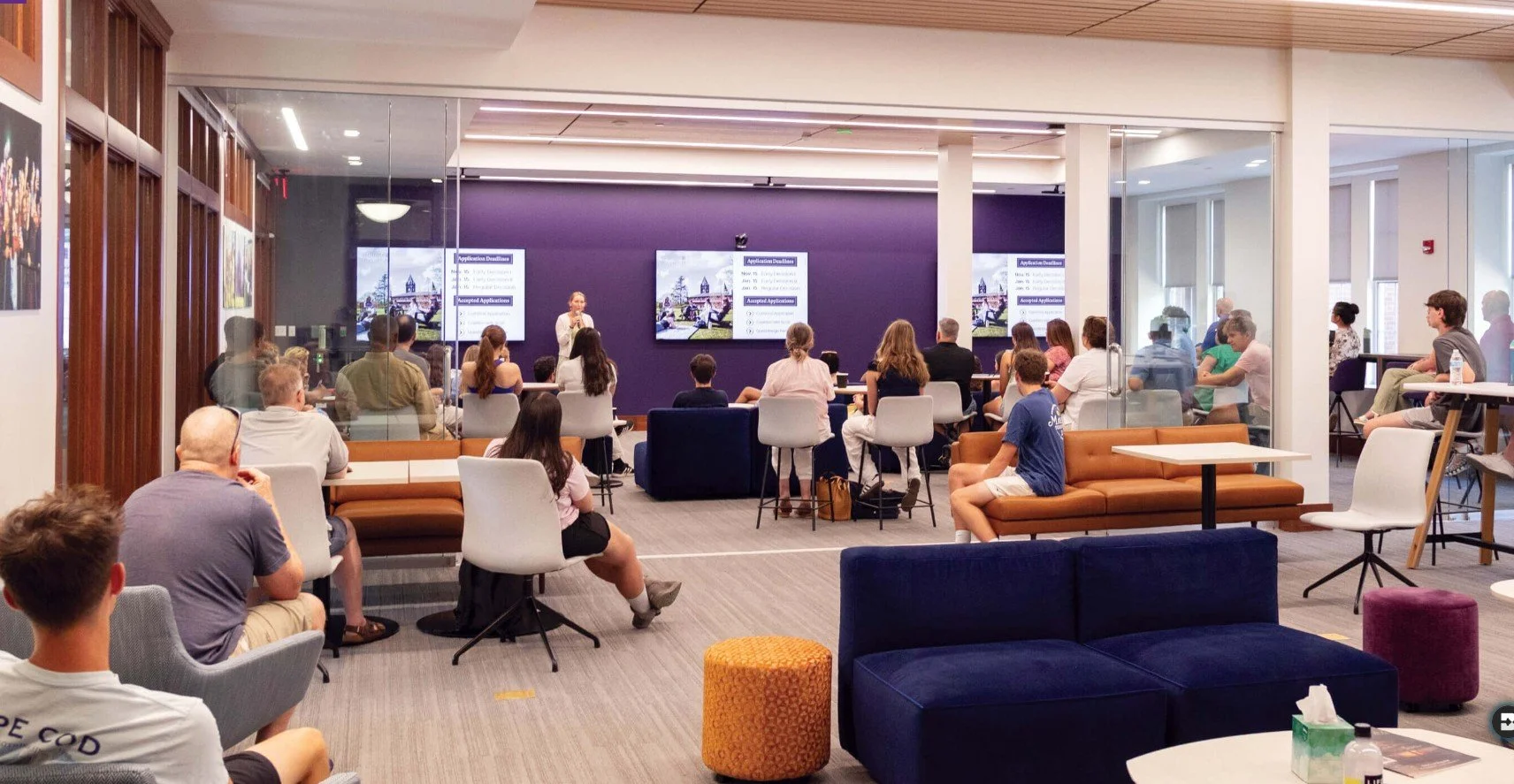
Last year and now this year, we held the breakfast and welcome session as well as the college programming sessions in this room, and NO students skipped anymore. They all wanted to be hanging out together in this bright and cozy space with the couches and tall tables, air conditioning, a quality coffee maker, and excellent technology. Having access to this room was truly a game-changer to the Bootcamp program!
The first two years, I was in the same classroom in the same building as the Enrollment Welcome Center, but for the past two years, I have been in an academic building nearby. This year was even better because I was on the main floor instead of the second floor, which made setting up and tearing down my room much easier - way less stairs to carry heavy bins up and down!
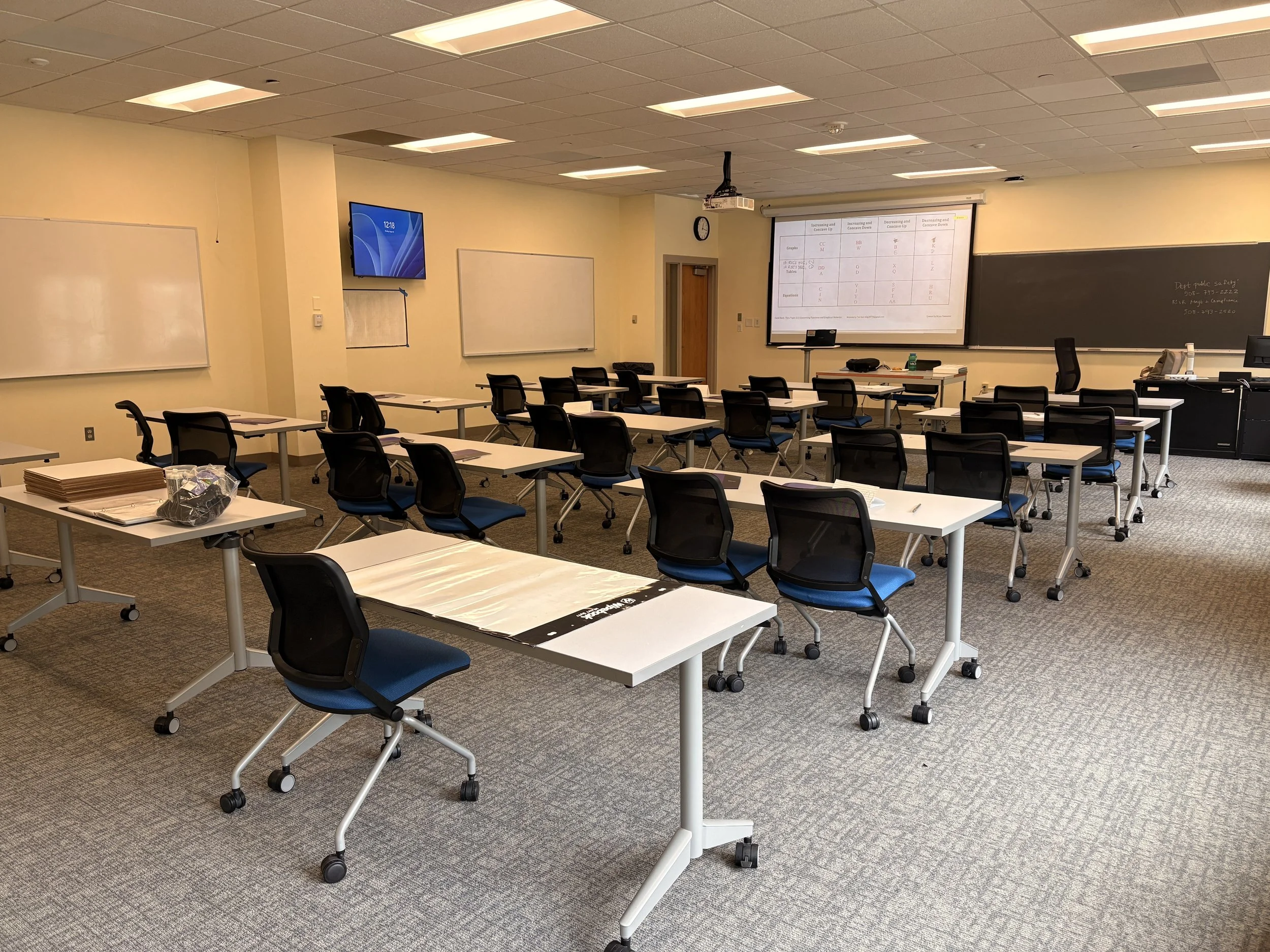
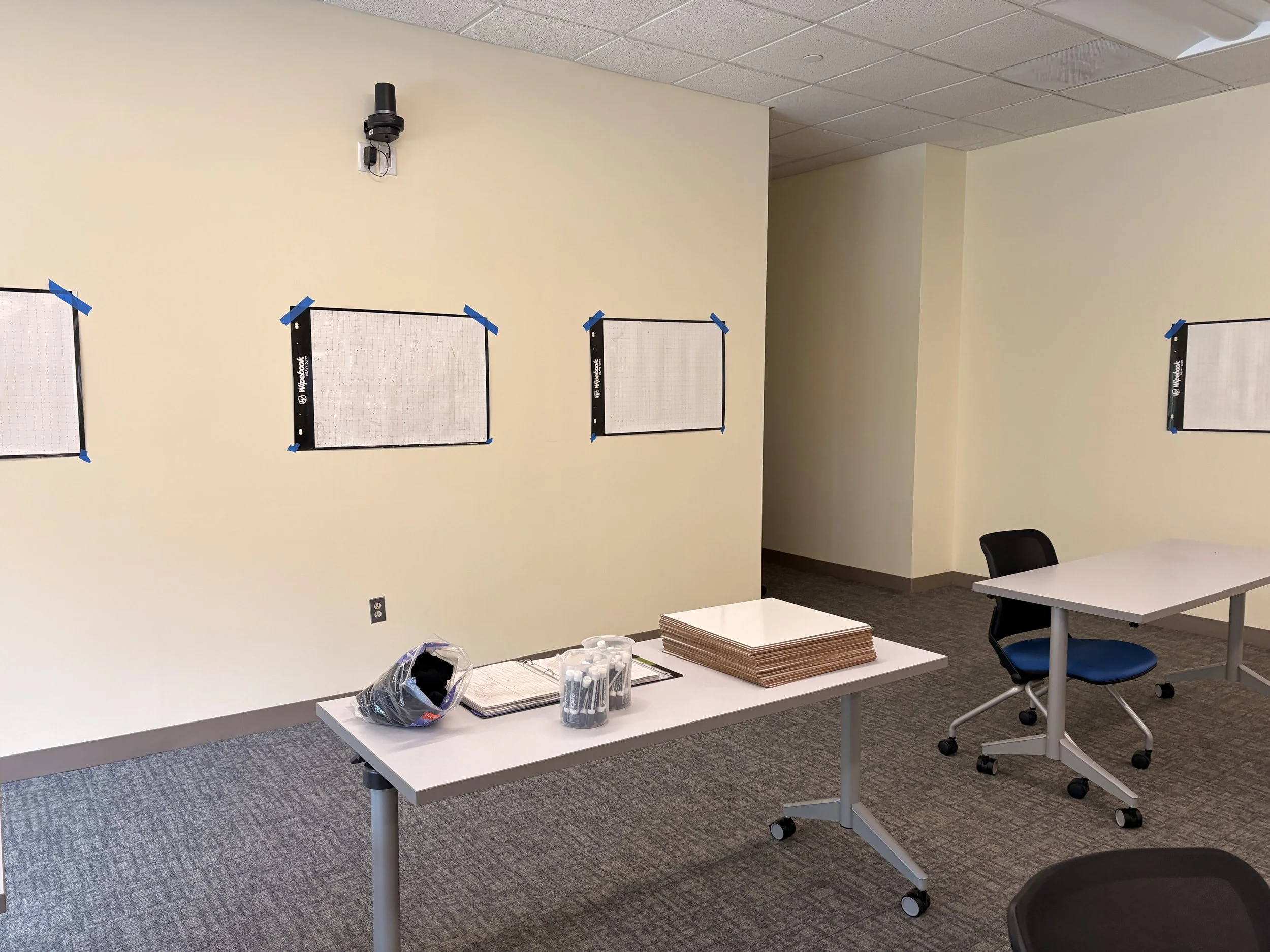
Here is what my classroom looked like from the back of the room. I prefer student desks in groups of 4, but these tables of pairs are still better than the individual attached desk+chair you sometimes still see in college classrooms.
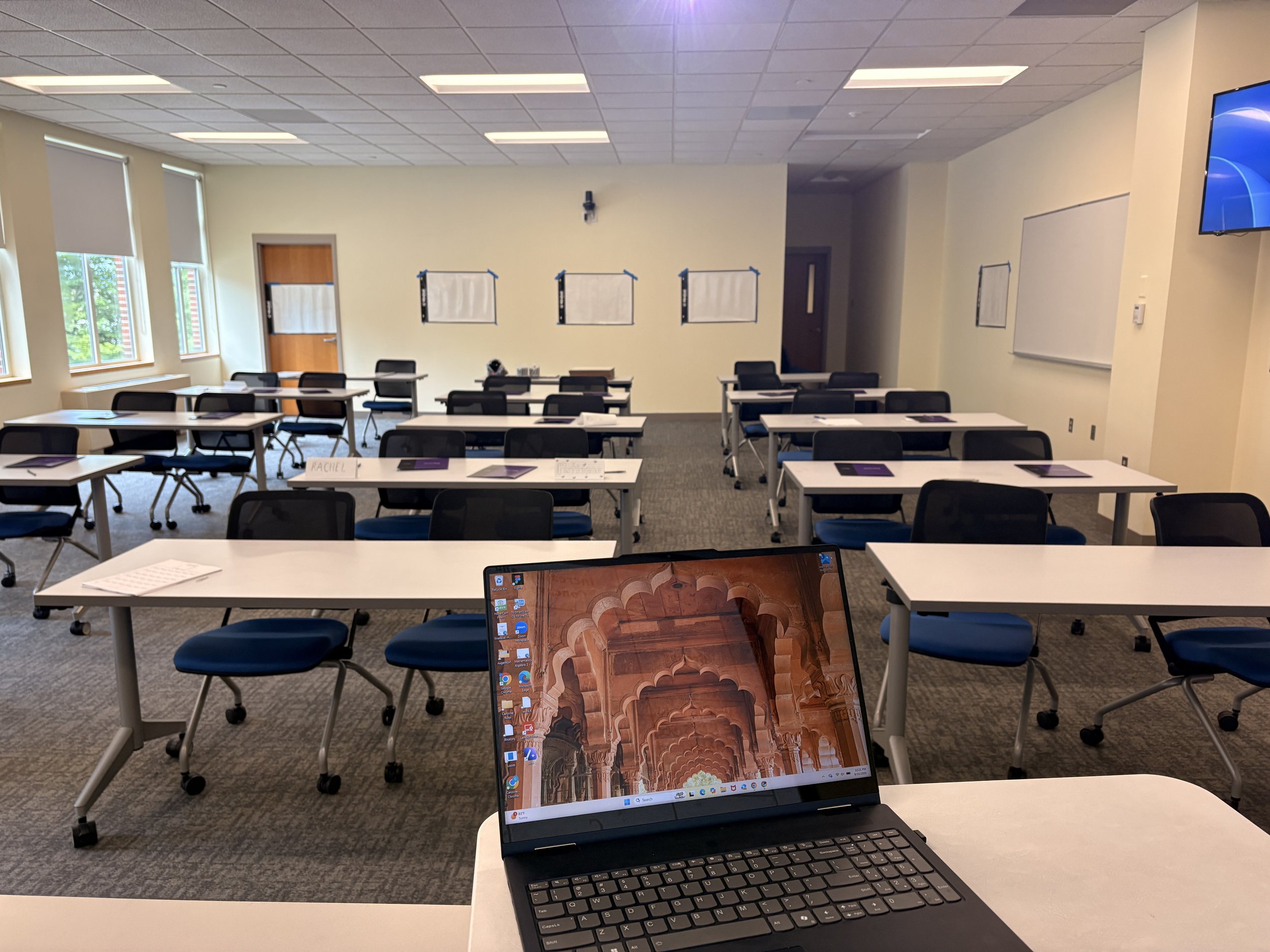
This is my view from the front of the classroom by my standing desk. I had my laptop and then document camera on this desk.
I removed chairs from the last row so that no one could sit in the way back and mentally check out. I used one of these tables for student supplies.
This side table is where I kept the graphing calculators, charging station, extra paper, and pens.
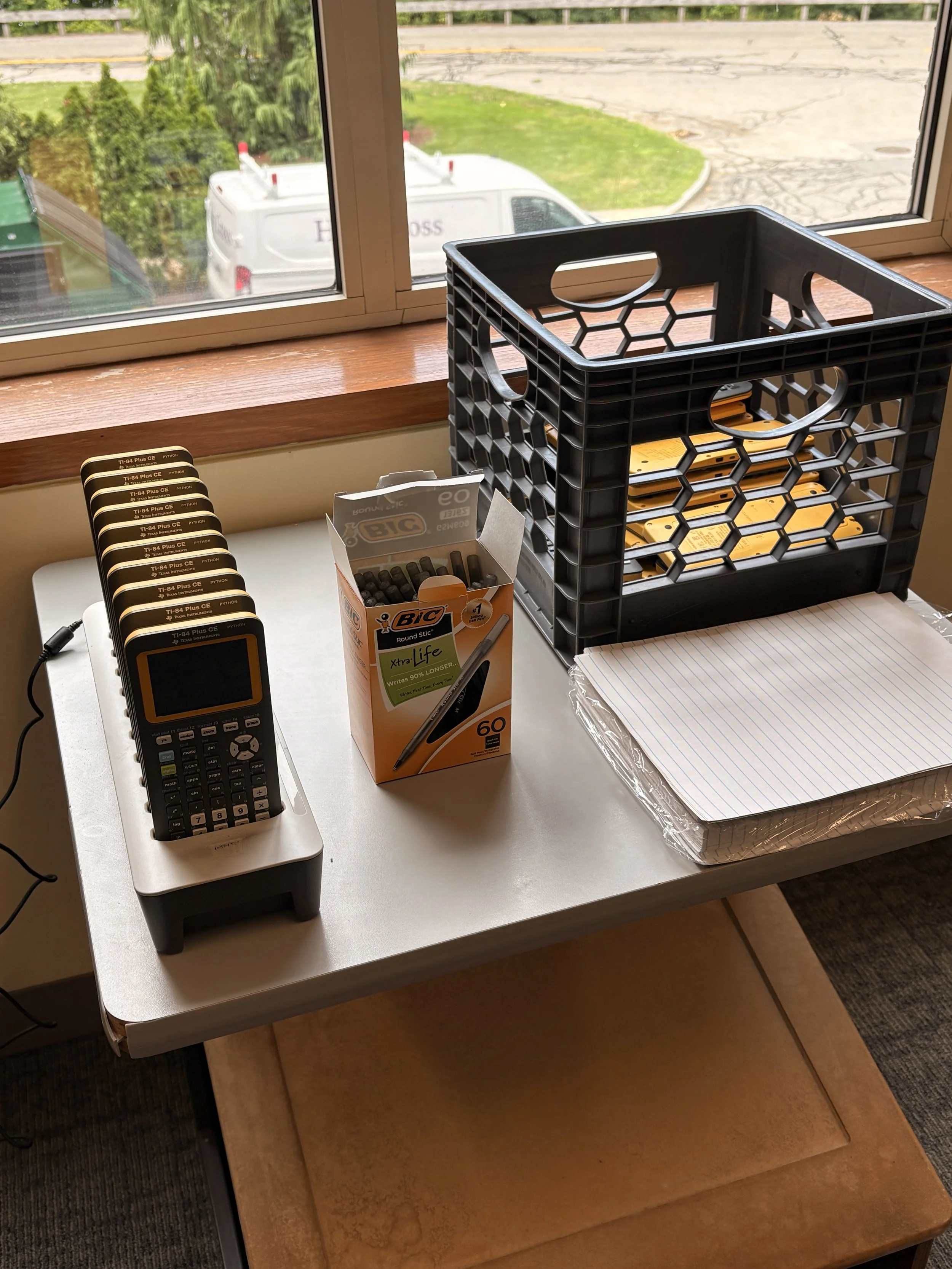
Each year, I go to the college a week early to drop off a big bin with all the copies for the whole week. Before going to the college, I go to my high school to make the copies. It takes me a few hours to make all these copies and organize them by day, but then I don’t have to worry about needing anything for the rest of the week. I also drop off a big crate with a class set of graphing calculators and charging station, document camera and cables, whiteboard markers and erasers. I also bring in Wipebook whiteboards to tape to the walls (I usually bring 13-14 of these), 16”x16” Showerboard whiteboards, and my binder of graph grids in page protectors so they serve a graphing whiteboards. It’s a lot to carry in and then carry out, but it’s important to me to keep the students highly engaged and periodically standing at the vertical whiteboards during our 3.5 hours together each day. I try to switch up our activity every half hour or so, and also include some card sorts, circuits, castle attack game, and many different types of worksheets.
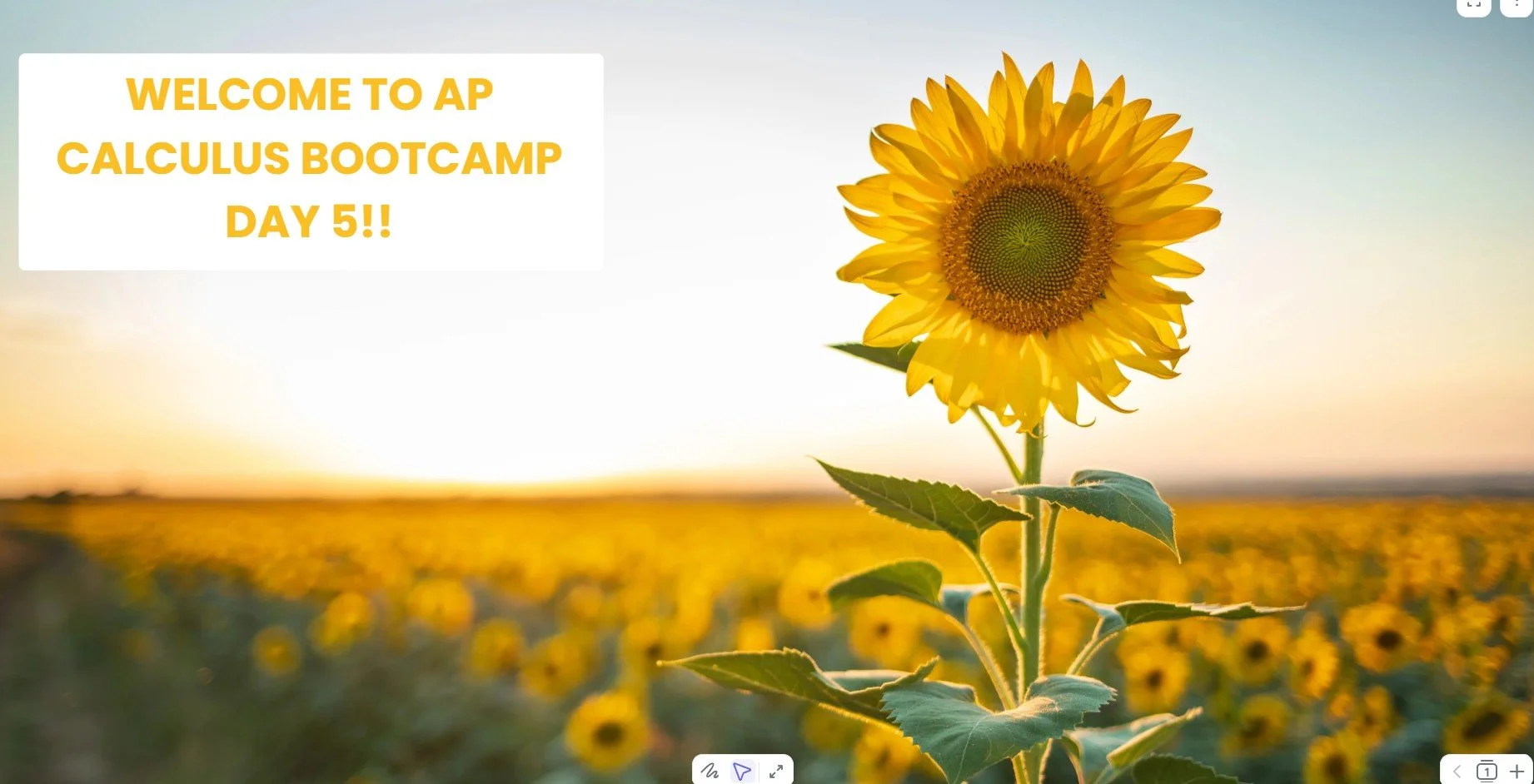
Every morning as students walked into my classroom from breakfast, they were greeted with a different Classroom Screen display. Here is the screen I used for the final day!
I still start and end the Bootcamp with a Pre-Test and Post-Test to (hopefully) show student growth. The students take the same 28-question “test” at the very beginning and very end, and this year, every student got a higher score on the post-test - yay!
Based on my own experience teaching AP Calculus and this year’s senior end-of-year surveys that overwhelmingly showed that students wished they had a better grasp of the unit circle before beginning AP Calculus, I decided to add in a NEW activity - UNIT CIRCLE BINGO!
For the past three years, I only had students do unit circle practice one day; I would give them a blank unit circle to fill out with a timer set for 10 minutes, and then they would refer to this when we practiced solving trigonometric equations.
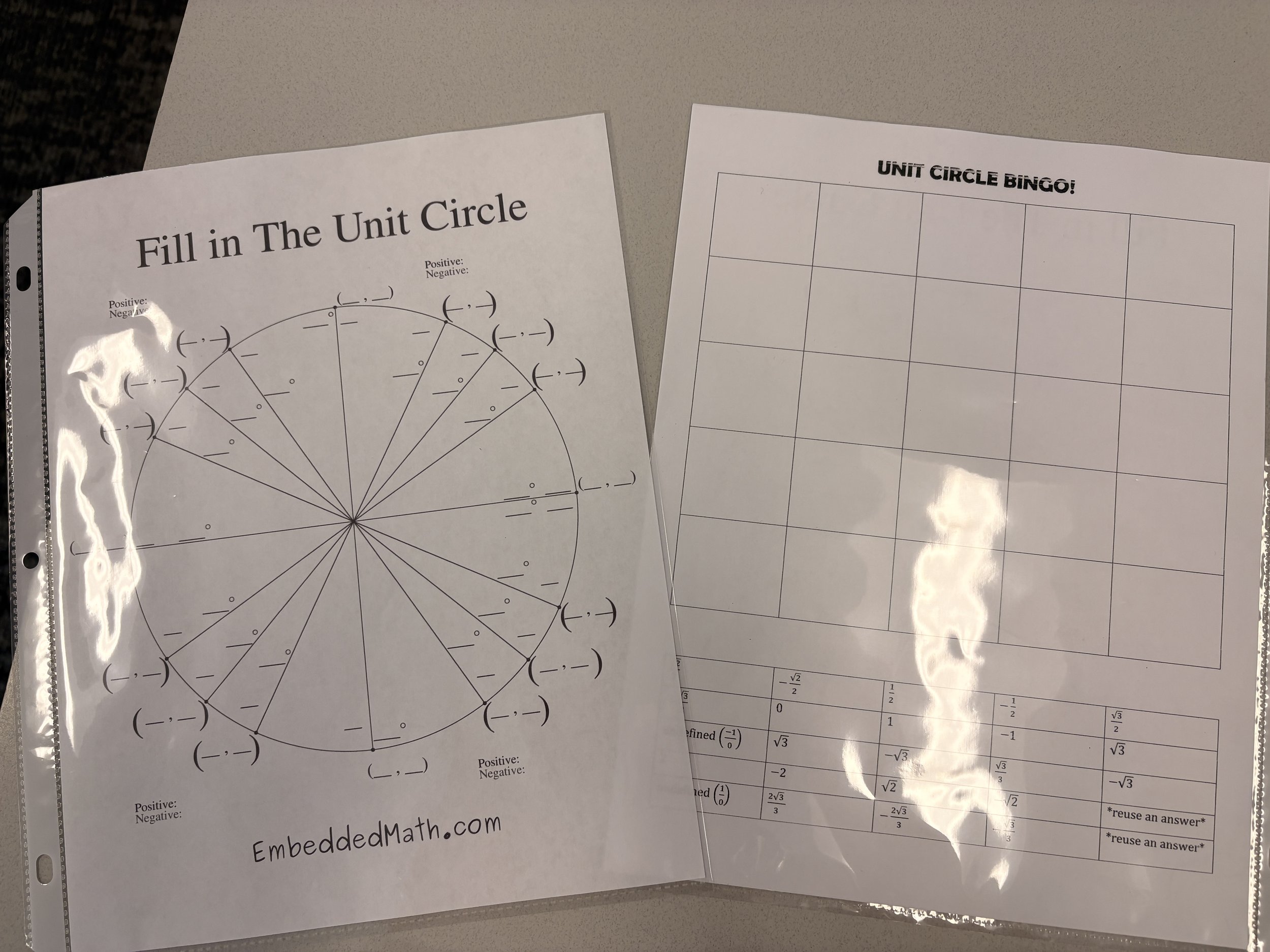
This year I decided to increase the amount of time we spent working with the unit circle. After their pre-test and a round of mad-minute arithmetic practice, I gave everyone a fill-in-the-blank unit circle (I’ve had this version from EmbeddedMath for years) to fully fill out. I gave them ten minutes and asked them to also include tangent values next to each ordered pair. They could work together if they wanted. Then I had them add in cosecant, secant, and cotangent values just in quadrant 1. Once everyone had time to check their answers with mine (projected on the document camera), I handed everyone a blank Unit Circle Bingo card sheet. I gave them a few minutes to fill in the “answers” at the bottom into the squares for the game. I advised them to try to fill in their boxes differently than other people.
Then they got a page protector and put in a NEW blank unit circle sheet and their filled-in Unit Circle Bingo sheet. They had to hide their filled-out unit circle in their folder so they couldn’t refer to it during the game. They could look at the blank one in the page protector if they wanted.
The week before the Bootcamp began, I created my own Bingo sheet and LOTS of question slips that contained EVERY unit circle question that can be asked. I formatted it so that when I printed it double-sided, the answers were on the back of each question. Not gonna lie, it took many hours spread out over a few days to get this fully done and formatted in a way I liked.
After all that time and effort, I made sure to start off every day with a mad-minute related to arithmetic and then two round of Unit Circle Bingo. During the game, they each got a whiteboard marker and sock eraser to mark off the squares based on what I called out, I gave them anywhere from 15-30 seconds between questions to think. The winner of each round got to pick a candy from the prize bag. I found out that NO ONE liked Snickers; gum was somewhat popular; but everyone seemed to want the Sour Patch Kids and Mike and Ike’s. I hadn’t expected this (because I love Snickers). I had bought a lot of Snickers and only a couple of the others, so I had to run to the grocery store twice during the week to replenish the prize bag!
When I created the Bingo card, I went back and forth debating if it should be a 4×4 square or a 5×5 square. I settled on a 5×5 square. There aren’t quite enough unit circle answers to fill in all 25 squares, so students got to pick two answers to reuse. I decided not to include a Free Space on the grid - they had to earn every spot! Throughout the week, I noticed that some of the rounds seemed to last longer than I was expecting, probably because there was no free space. There were some rounds where I pulled over 10 different questions before someone got a Bingo! If I were to revise the Bingo Card, I would probably add in a Free Space and get rid of one of the reuse an answer spaces.
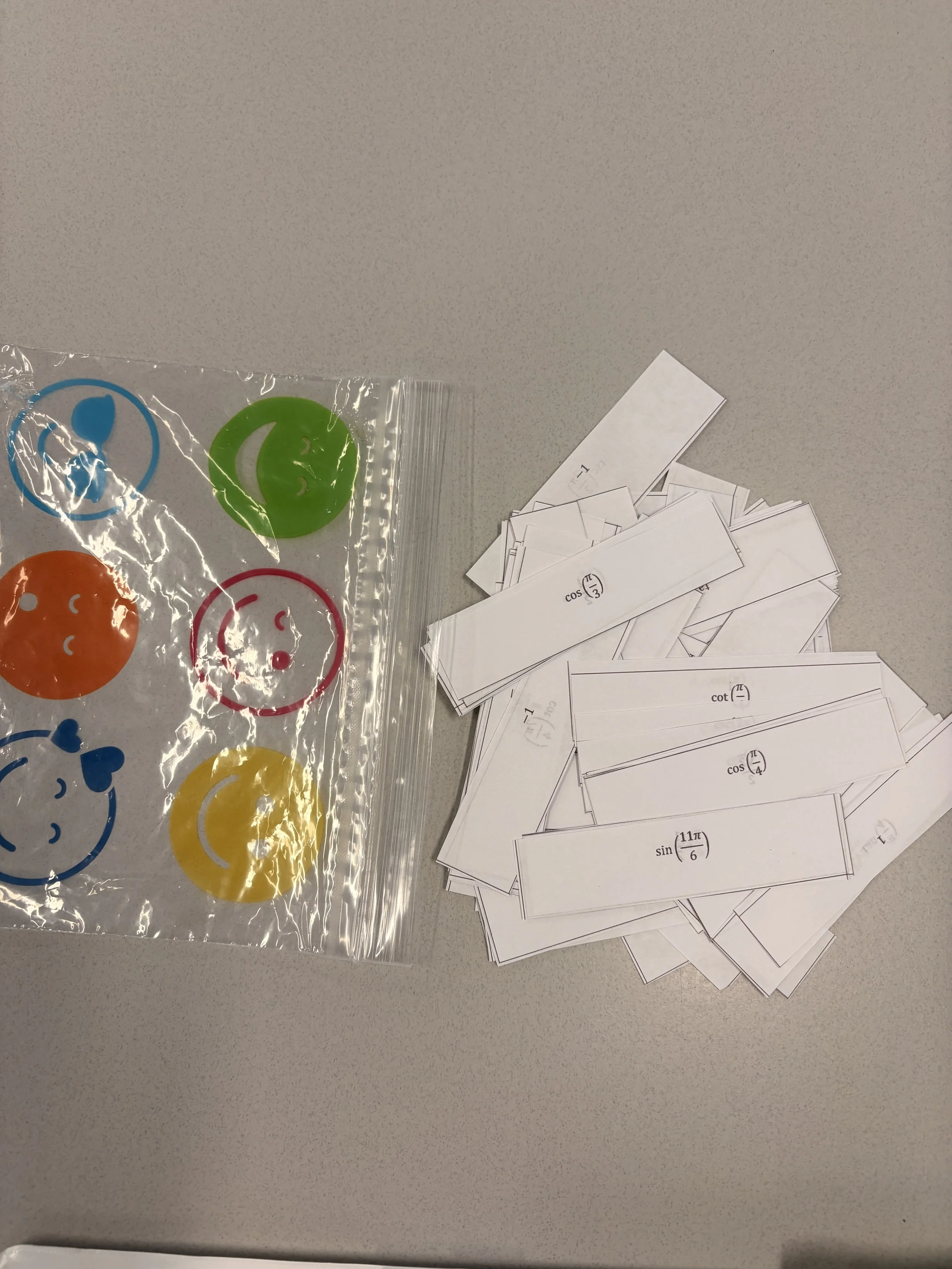
This year, I spent less time on reviewing Inverse Functions and mentally evaluating Logarithms, since overall the group was strong with those concepts. I spent more time practicing Complex Fractions, the Unit Circle, and Trig Equations.
Overall, the week went very smoothly without issue, and it got me back in the mindset of teaching after being away from a classroom for the whole summer so far. One more week until school begins - summer always goes by too fast!