Notebook Guidelines for High School Math (interactive notebook) *UPDATED*
Two years ago, I wrote THIS blog post when I first began incorporating quarterly notebook checks in my sophomore Algebra II class. I had yet to try it out, and after two years of using organized, systematic notebooks, I learned a lot and adjusted as needed.
Last June, at the end of my first year of notebook checks, I replaced the fourth quarter notebook check with a Google Doc reflection form. This was partly because I had just come back from a one-month absence to recover from surgery, partly because I didn’t have time to grade 80 notebooks right before final exams and the AP reading, and partly because I was really looking for some student feedback and suggestions.
The student feedback varied greatly from bare minimum, hasty answers to some really great suggestions. There were a few strong criticisms of the forced structure and guidelines of the notebook, but most students appreciated how much the process improved their organization. I loved how much the notebook checks improved the overall structure of the class and am hoping to continue using this interactive notebook for the foreseeable future. I no longer have to worry about students losing things or having hundreds of loose papers floating around in their backpack for my class. Anytime I need them to find anything, they can just flip back in their notebooks. They have a clear routine for the class and know what to do: the day typically starts with a warm-up in section 1, and if we aren’t at the VNPS (vertical whiteboards) or doing a Desmos or TI-84 activity, then they move to the classwork sections. Homework has its own section as well.
The first thing that changed was how I structed the notebooks; previously I did the following:
Subjects 1, 2, 3: Video notes, classwork, 1/2 sheets of problems, taped discovery activities, etc
Subject 4: All bookwork or online PDF homework
Subject 5: Warm-up problems
I got feedback that Section 4 was underutilized (due to most bookwork being CYU and thus optional) and there wasn’t enough room in Section 5 for an entire year’s worth of warm-up problems. Based on this feedback, I changed the sections to the following:
Subject: Warm-up problems
Subject 2: FIRST half is a continuation of warm-up problems; SECOND half is all bookwork/homework/CYU problems
Sections 3, 4, 5: CLASSWORK sections, including video notes, classwork, 1/2 sheets of problems, taped discovery activities, etc
I greatly improved the structure of the warm-up section by changing the labeling requirements. Each year, I compile all warm-ups problems on a Google Slideshow that students have access to on their Google Classroom. if they are absent, they need to make-up the warm-up problem by checking the slideshow. Last year, I made each week of questions a different color, and I told students they needed to use a new page for each week, with two problems on the front and two problems on the back. Even if the two problems only took up half the page, the third problem of the week should go on the back side of the page with the fourth problem.
A question from the Google Slideshow from last year looked like this:
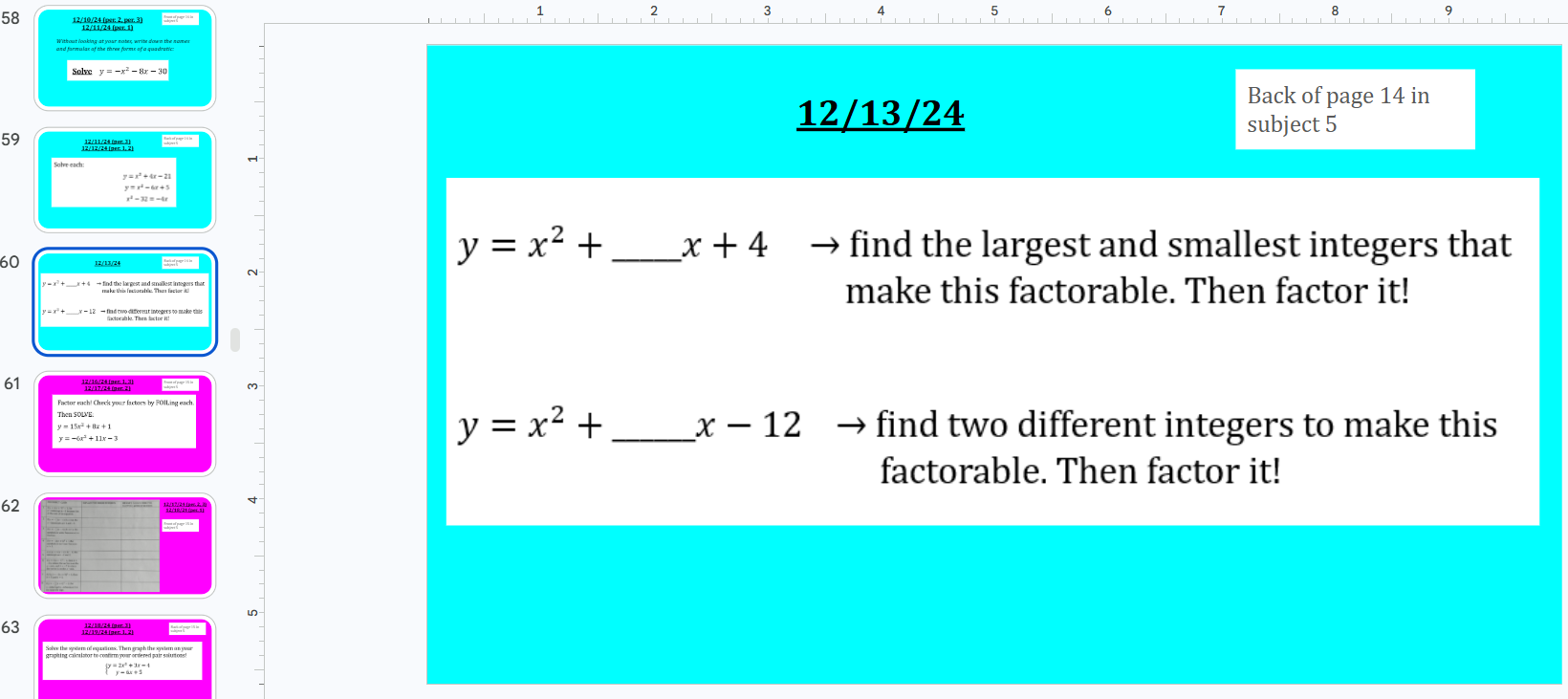
This was NOT a good way to do it. Grading warm-up problems when I collected notebooks was a nightmare. As you might be able to imagine, students had a hard to remembering to only do two problems per side, some were very irked that they had to waste space and go to the back if they still have room on the front for all four problems, and some students needed MORE space and then had to go to a third side for the week - then what? It’s actually mentally exhausting just looking back on how annoying this set-up was!
I love how I structed it for this year: each warm-up problem is numbered and dated, and students need to number and date each question in their notebooks. This makes is SO MUCH EASIER to check when I collect and grade notebooks! Last year, students did not number the questions, they just dated them.
Each period gets its own color slides; they are no longer color coded by week. Students can use as much room as they want on warm-ups, but my request was that they left two lines blank between problems and that they didn’t put more than three warm-up problems per side (I had to add this in because otherwise some students WILL write miniscule and try to fit in as many problems as possible to ‘save paper’).
Here are a couple samples of warm-up slides from this year:
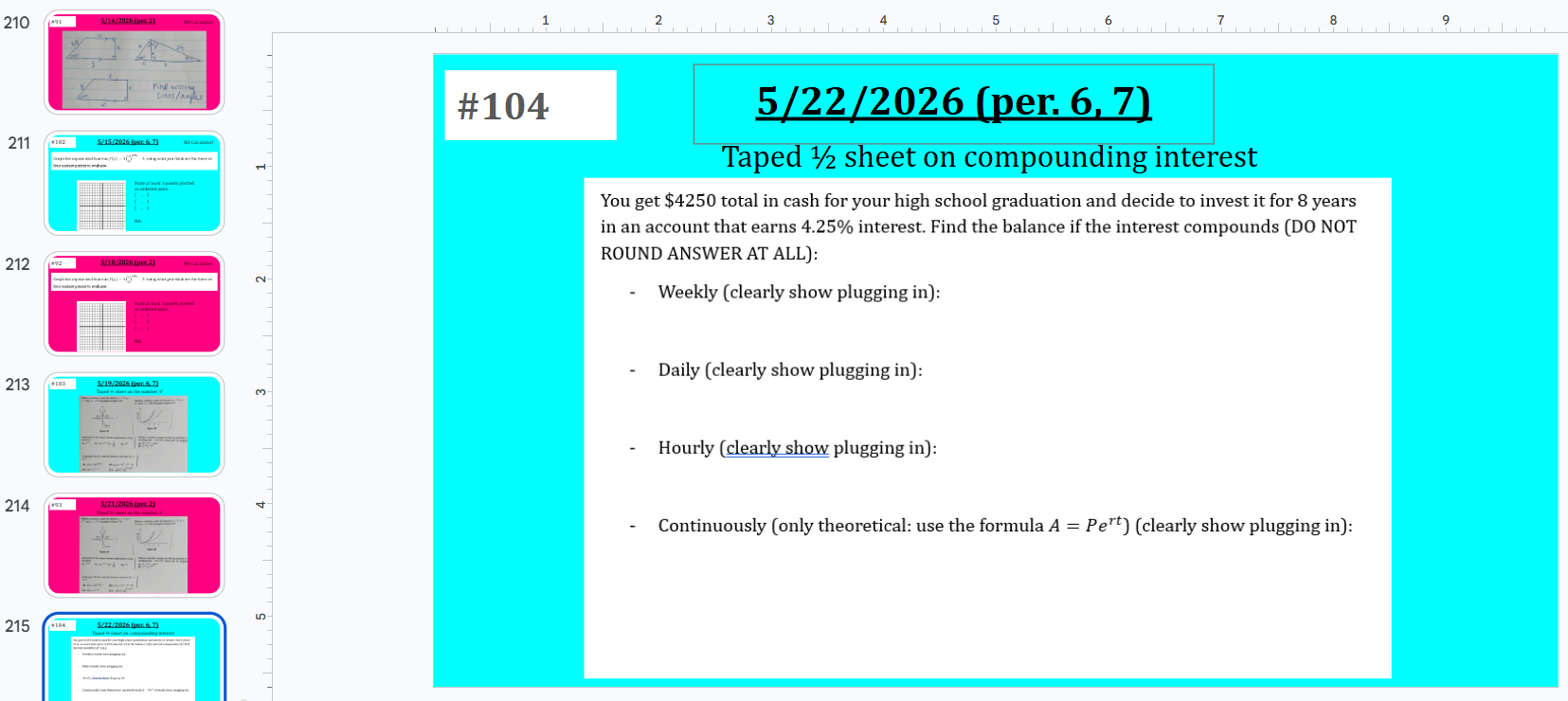
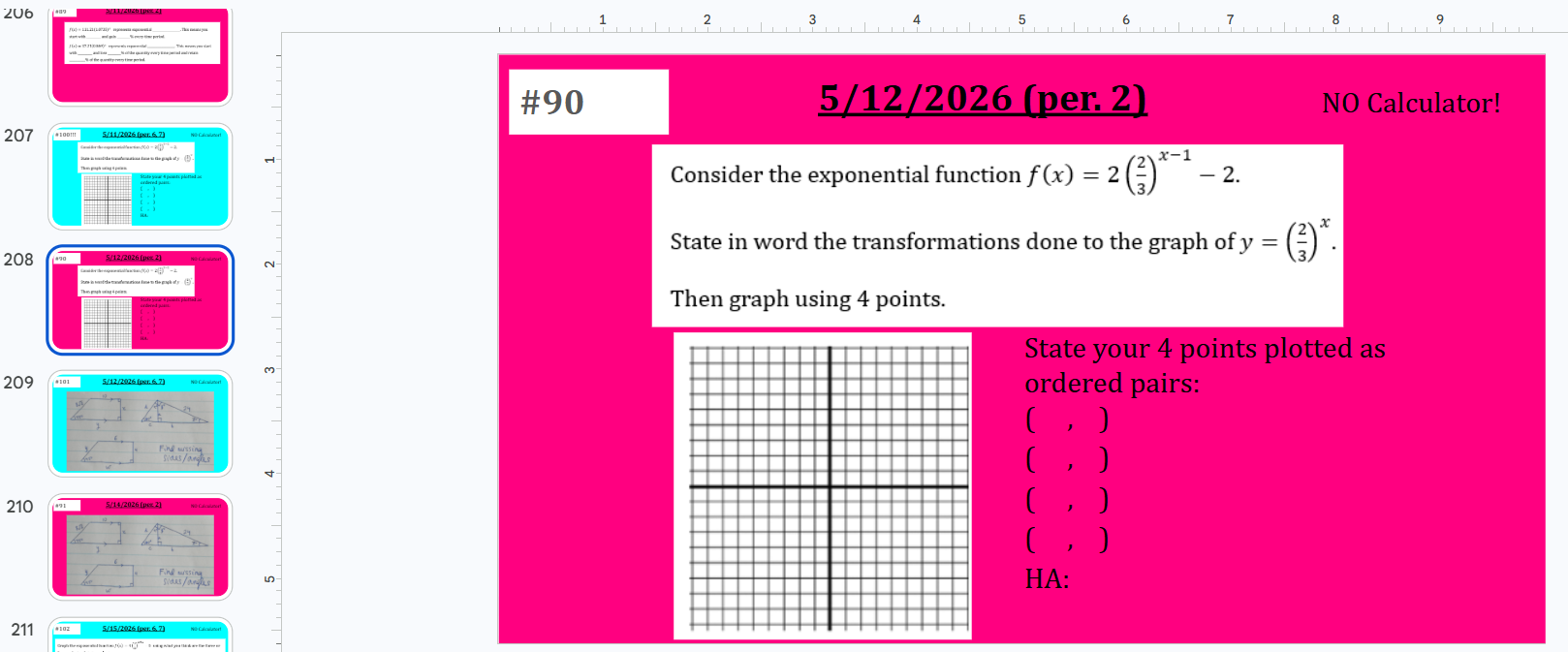
Sometimes the warm-up is a taped slip with the question or graph already on it, and sometimes students write down the question themselves. It does save time having it already typed for them on a slip of paper, but if it’s a short or simple question, then they can write it themselves.
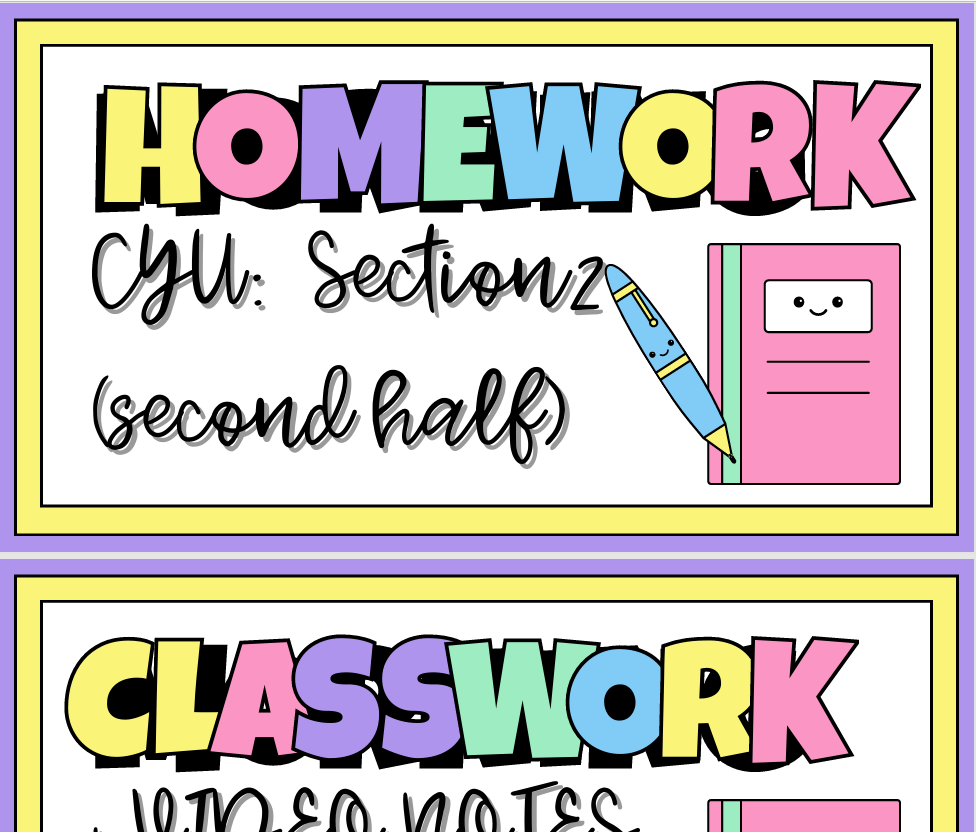
Some students last year had trouble remembering which section was for which purpose. They would do homework in the warm-up section, or not realize until the end of the quarter when notebooks were due that they had set up their notebook entirely wrong. To avoid this, I made section labels and copied them on colorful cardstock paper. I spent time at the beginning of the school year having students tape in labels for each section. This helped a LOT and I actually did not have a single student mess up the sections.
The labels were made on Canva (link HERE) by editing a previously created design and they look like this (PDF link HERE):
I collect notebooks at the end of each quarter and flip through each students’ notebook. This is not a hasty scan of a check; I look at each warm-up problem and each classwork item. At some point during the process, I hate my life and dread the entire process. BUT when notebook checks are done and returned, I get such a sense of accomplishment. The first quarter notebook check takes the longest. Students aren’t used to the process and some notebooks are not done well because students haven’t realized that I really do check every page. By the third quarter, the notebooks are typically very well prepared and self-graded.
Here are what the checklists look like:
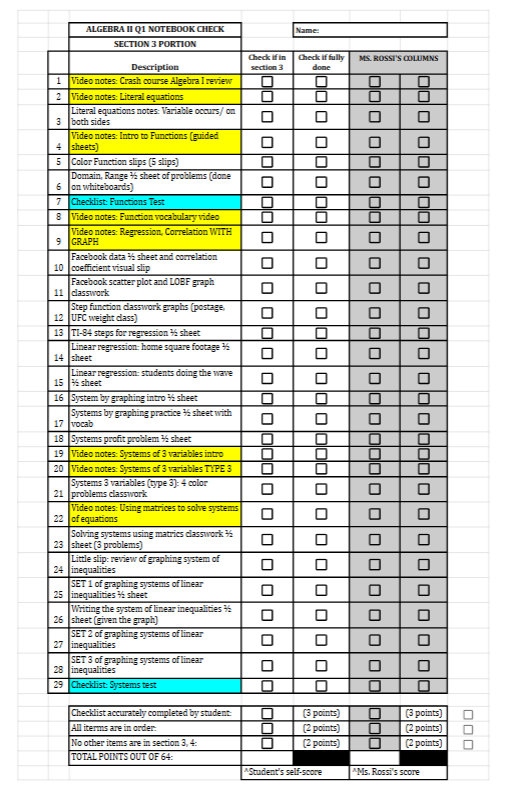
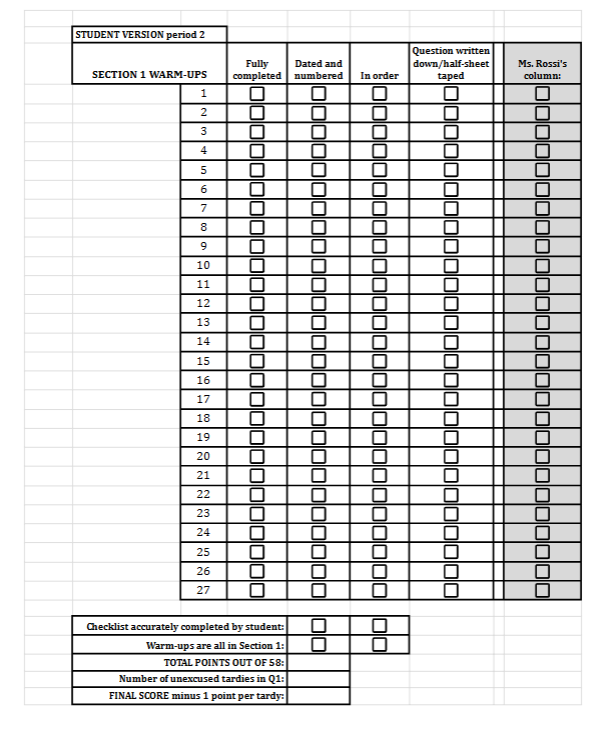
Here are Google Slides versions of three quarter’s worth of checklists:
One thing I learned last year is that students NEED to self-grade their notebooks before turning them in. This forces them to really consider each item and if they truly have it completed in their notebook. I used to just have a checklist without the self-grading section at the end. Students would just mindlessly check off each item without actually looking and then hand it to me to deal with. Students could still just make up a self-grade score, but they lose points if their self-score is not at all accurate.
Another thing I learned the hard way: do not let students hand in their notebooks until they show me the fully completed checklists with a self-score at the bottom. The first time I ever collected notebooks, about half of the checklists weren’t done, which meant students hadn’t checked their notebooks at all, and it took me forever to go through them.
Another note on the notebooks: it really makes a difference what kind of 5-subject notebook students use. I always ask students to get a full-sized notebook (some are smaller than an 8.5×11 sheet of paper, and this can make it tricky to fit some taped sheets down) that has a plastic cover (paper covers will not last as well through an entire year of daily use) and section dividers that are folders (for storing quizzes and other handouts). I send THIS link home to all future students in June so they have plenty of time to plan ahead for school supplies, and I also buy about 5 myself to hand out to students who are not able to get one.